



She might stretch, drink water or make her bed.
It is a small morning ritual, but it reflects the philosophy behind her new book, Rising with Dignity: The African Stoic, The Rwandan Way, a book about learning to manage what is within your control and respond thoughtfully to everything else.
For Uwanziga, Stoicism is not about becoming emotionless or simply enduring whatever life brings. It is a practical way of thinking about everyday life, how to deal with disappointment, manage anger, respond to pressure and, perhaps most importantly, how to get back up after falling.
The more than 250-page book took five years to complete, but its beginnings were much more modest, she told IGIHE in a recent exclusive interview.
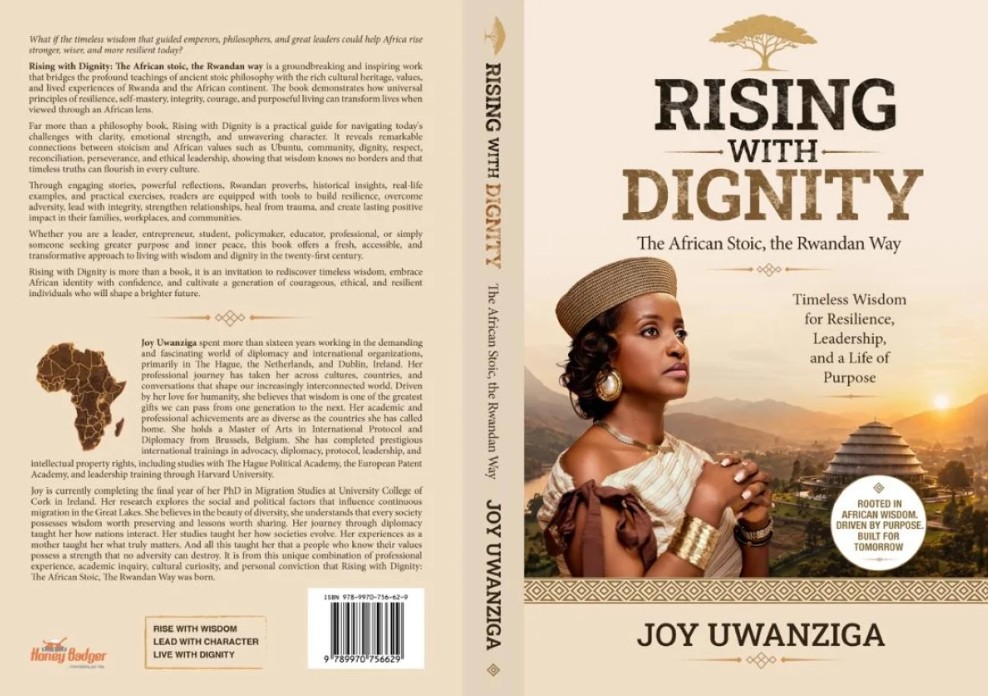
Uwanziga started by writing notes to herself, passages and reflections from Stoic philosophy that resonated with her. Over time, she began sharing some of those ideas with friends and family, eventually realising they could become something larger.
The book launches at Marriott Hotel Kigali on August 29 and will later be available through Amazon and bookstores in Rwanda.
Uwanziga is currently completing a PhD in migration studies at University College Cork. Before moving to Ireland, she spent several years at the Rwandan diplomatic mission in The Hague as a consular affairs officer. Rising with Dignity is her third book, following Manners in Rwanda, published in 2015, and a 2018 book on parenting.
A philosophy Rwandans already know
Uwanziga's interest in Stoicism began with Marcus Aurelius's Meditations, the Roman emperor's private reflections that have remained influential centuries later.
What drew her in was a powerful principle centred on separating what we can control from what we cannot.
“You can't control external events, so don't let them control you by the way you react,” she says.
It is a principle that can easily be applied to ordinary situations. You can prepare for an examination, but you cannot control the questions. You can choose your words in a difficult conversation, but not how another person responds. You can decide how you begin your morning, but not everything that will happen before the day is over.
For Uwanziga, this way of thinking also has a familiar African dimension.
She points to the historical relationship between Greek philosophy and Egypt and argues that some values associated with Stoicism have parallels in African traditions that were passed down orally.
“When you put Emperor Marcus Aurelius and a Rwandan or African elder in a room, they would practise or say things about Stoicism, maybe with a different name,” she adds.
“We've been practising Stoicism without calling it Stoicism.”
She is careful not to present this as a claim that Africans invented Stoicism. Rather, she sees it as a recognition that different cultures can arrive at similar principles, including integrity, discipline, responsibility and resilience.

What happens after failure?
For Uwanziga, one of the most important tests of character is what happens when things do not go according to plan.
She uses the example of a student preparing for an examination. The student can control the effort put into studying, but not the questions that appear on the paper or how it is marked.
What remains within her control is how she responds.
“Do we rise with dignity?” Uwanziga asks. “Because we fail every day.”
That idea gives the book its title and connects philosophy with one of Rwanda's most recognisable qualities, resilience.
Uwanziga sees Rwanda's recovery after the 1994 Genocide against the Tutsi as a powerful example. She recalls how people were forced to take on responsibilities beyond their previous professions because the country needed to be rebuilt and there were not enough people with the necessary skills.
Seeing people start again and contribute to rebuilding Rwanda deeply influenced her.
But Uwanziga is careful not to romanticise suffering.
Resilience, she argues, should not mean pretending that pain is easy or expecting everyone to cope in exactly the same way. People process difficult experiences differently, and sometimes they need psychological or other forms of support.
“What's wrong with asking for help when you need it?” Uwanziga asks.
For her, rising with dignity does not mean denying pain. It means finding a way forward while accepting that support may be part of that journey.

Calm does not mean silence
Asked whether Stoicism means staying quiet in the face of injustice, Uwanziga pushed back on that idea.
“If you have to talk, talk with wisdom,” she stresses. “But if being silent will help more until you calm down and think of a wiser response, then be silent.”
Asked how that applies beyond individual situations, she pointed to leadership in everyday life, parenting, teaching, leading a student group, even managing a WhatsApp group, saying the question in each case is whether a response will improve things or make them worse.
On anger, she gave a similar answer.
“You are allowed to be angry, but don't take a decision when you're angry,” she said. “Think about it.”
Dignity, agaciro and strength
On whether a person can lose everything and still retain their dignity, Uwanziga connected the idea to the Rwandan concept of agaciro, self-worth expressed through conduct, and inyangamugayo, referring to a person of integrity. For her, dignity is not dependent on wealth, status or circumstances.
“Losing what you have, or the most valuable thing, and still living with dignity, we (Rwandans) are a good example,” she affirms.
She also challenged expectations around masculinity.
Uwanziga said boys are often taught to “man up” when they are hurt, creating an idea of strength that can make men reluctant to acknowledge pain or seek help.
Her message carries a deeper truth that emotional honesty does not cancel out strength.
“Men are allowed to have feelings too,” she argues. “You are human the same way everyone is.”
That is consistent with her broader understanding of Stoicism. The goal is not to stop feeling, but to recognise feelings without allowing them to dictate every decision.
Practising what she writes
Uwanziga does not claim to have mastered the philosophy she writes about.
She describes herself as “a very emotional person” who cries easily, including at weddings, and says regulating her own emotions remains one of the most difficult parts of Stoicism for her.
That honesty is part of what makes her interpretation of the philosophy feel less like a set of rules and more like a practice.
Her morning routine is one example.
Rather than immediately reaching for her phone and allowing social media and the news to influence her mood, she tries to do something for herself first. Stretching, drinking water and making her bed create a small buffer between waking up and confronting the outside world.
She also tries to appreciate ordinary moments, a cup of tea, a hug from a loved one, rather than waiting for major achievements to provide happiness.
From personal notes to a reminder
The book eventually became a 12-chapter work, but Uwanziga still describes its message as less about discovering something new and more about remembering values that are already familiar.
She believes integrity, discipline, responsibility and resilience remain particularly important for young people navigating pressure, ambition and the temptation to look for shortcuts.
“We just want to live an easy life; we don't want to go the hard way,” she remarks. “But then what are the results of the shortcuts?”
For Uwanziga, Rising with Dignity is ultimately an invitation to slow down before reacting, focus on what can be controlled and consider the kind of person one wants to be when circumstances are difficult.
Asked for the single most important lesson she hopes readers take from the book, Uwanziga offered a direct answer. “To be a man or a woman of integrity.”
Watch the full video below to learn more about the book and what Uwanziga stands for.
Loading comments...
Leave a comment