



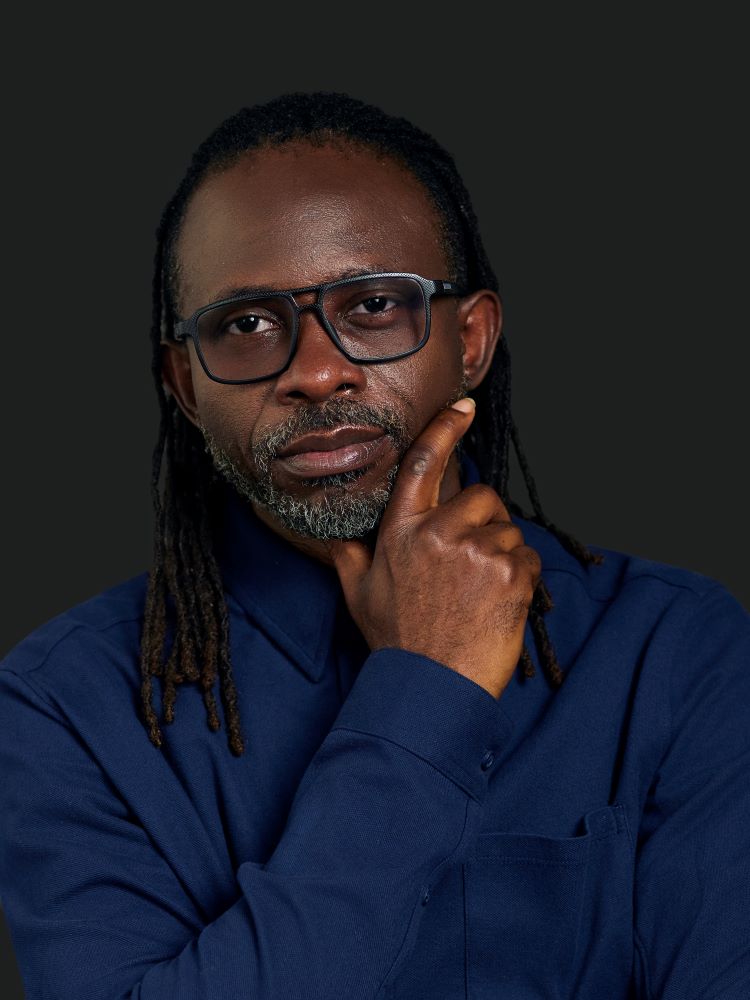
After years of working internationally across design, product management, digital transformation and venture building, he had become more interested in a much bigger question: What does it take to build the people, businesses and systems behind successful technology?
His career had taken him across industries including healthcare, education, telecommunications and technology, working with both large institutions and early-stage ventures. He began professionally in design before expanding into product management, innovation and digital transformation.
Eventually, his interest shifted from simply building products to understanding the ecosystems that make those products possible.
That thinking brought him to Kigali.
“I chose Kigali as a gateway back to Africa because of its digital readiness and willingness to align with the world’s technology advancement,” Akinrinmade said.
“I didn’t come here simply to build another technology company. I came here to build, learn, collaborate, and contribute.”
For Akinrinmade, Rwanda offered something important to entrepreneurs and technology professionals looking at Africa: a country that has made technology a deliberate part of its development strategy.
Over the past two decades, Rwanda has steadily invested in digital infrastructure, public digital services, innovation, skills development and a policy environment intended to encourage technology companies and entrepreneurs.
Today, Kigali is home to a growing network of technology companies, startups, universities, innovation programmes, investors and institutions.
The country has also continued to invest in initiatives including Kigali Innovation City, digital public infrastructure, broadband expansion and programmes designed to support startups and emerging technology businesses.
For Akinrinmade, however, what stood out was not simply the infrastructure.
It was the intention behind it.
“Professionally, what attracted me was the opportunity to build in an environment that is very intentional about technology, innovation and development,” he said.
Having spent a significant part of his career working internationally, he had seen what strong institutions, good systems, technology and access to experienced talent could make possible.
Rwanda offered an opportunity to bring some of that experience into an African environment while also learning from the ecosystem already developing here.
“I’m not coming here believing that I have all the answers,” he said. “I’m coming with experience, but also with a willingness to learn and collaborate.”
“For me, Kigali is a place where experience, talent, ideas and opportunity can meet.”
Building more than software
That philosophy is now taking shape through AsteriskRD Tech, the Kigali-based technology, innovation and capacity-building organisation Akinrinmade is developing.
The idea behind AsteriskRD has been evolving for several years.
In its earliest form, Akinrinmade envisioned something closer to a conventional technology and software development company. But his experiences building products and working with different ventures gradually changed his thinking.
He began asking questions that went beyond software development.
Where does a good product idea come from? Who understands the customer well enough to know what needs to be built? Who knows how to transform an idea into a sustainable business? Who develops the people capable of building those businesses? And what kind of environment allows experimentation to happen?
Those questions ultimately expanded the vision for AsteriskRD.
Today, Akinrinmade describes the organisation as being concerned not only with software development, but with research, innovation, product development, venture building and the development of the people and capabilities required to make all of those things possible.
“At its simplest, AsteriskRD is a technology, innovation and capacity building organisation,” he said. “But I don’t want it to be just another company that builds software for clients.”
The organisation intends to identify problems, research opportunities, develop technologies and products, and help promising ideas develop into viable ventures.
An equally important part of that model is developing talent.
AsteriskRD is creating programmes aimed at students, graduates, founders and early-stage innovators, particularly around product thinking, innovation, venture building and the process of moving an idea towards a minimum viable product.
“Ultimately, I want AsteriskRD to become an ecosystem where people can learn, experiment, build, collaborate and create,” Akinrinmade said.
“The technology is important, but the bigger ambition is to build the capability around the technology.”
Rwanda’s next technology opportunity
This emphasis on capability comes at an important time for Rwanda.
The country has already made significant progress in laying the foundations for a digital economy. Rwanda has built extensive telecommunications infrastructure, digitised numerous government services and created policies intended to encourage innovation and technology entrepreneurship.
The country has also increasingly positioned itself as a place where African and international companies can develop, test and scale new solutions.
That progress means the conversation is gradually moving beyond whether the infrastructure exists.
The next challenge is ensuring that Rwanda and the continent develop enough people who know how to turn that infrastructure into companies, products, services and jobs.
It is a challenge that Akinrinmade believes extends beyond Rwanda to much of Africa.
For years, technology skills programmes across the continent have successfully encouraged more young Africans to learn coding, design, entrepreneurship and other digital skills.
But Akinrinmade believes there is still an important gap between knowing something theoretically and being able to apply it to a real problem.
“One of the biggest gaps is the difference between learning about something and actually being able to do it,” he said.
Someone may graduate understanding the theory of technology, business or design, he explained, but still struggle when required to identify a real problem, understand the people experiencing it, develop a solution, test that solution and determine whether people actually want it.
A second challenge is the way disciplines are often taught separately.
“The developer learns development. The designer learns design. The business student learns business, but building a real product requires all of those things to come together.” Akinrinmade said.
This is one area in which Rwanda's evolving technology ecosystem could have an impact beyond its borders.
As Rwanda attracts technology companies, innovators, researchers and entrepreneurs, Kigali is increasingly able to serve not only as a market for technology, but as a place where ideas can be developed and tested.
Akinrinmade believes that the environment provides an opportunity to experiment with new approaches to developing African technology talent.
Learning how to solve problems
Central to AsteriskRD’s approach is what Akinrinmade calls product thinking.
It sounds like a technology industry term, but he describes it more simply: learning how to understand a problem before rushing to build a solution.
A company may have a good idea, sophisticated technology and even access to investment, he argues, and still produce something people do not need.
Product thinking forces a builder to ask more fundamental questions.
Who is the user? What problem is being solved? Why does the problem matter? What business model makes sense? What should be built first? How should it be tested? What is being learned from the process?
And perhaps most importantly: Should this product be built at all?
“It’s not just about becoming a product manager,” Akinrinmade said. “It’s a way of thinking that can make a developer, designer, entrepreneur, executive or student better at solving problems.”
That distinction is important for an African technology sector increasingly focused on building commercially sustainable businesses rather than simply producing more startups.
A product must solve a real problem. Someone must be willing to use it. In many cases, someone must ultimately be willing to pay for it.
For Akinrinmade, practical experience is therefore more valuable than another certificate.
When people complete an AsteriskRD programme, he wants them to be able to say that they identified a genuine problem, spoke with the people experiencing it, developed an idea, tested their assumptions and understood what would be required to build the solution.
The final outcome might be a prototype, an MVP concept or a business model.
Sometimes the most valuable result might even be discovering that an idea should not be pursued.
That, Akinrinmade says, is also successful product thinking.
“I want them to leave with confidence,” he said. “Not confidence because they received a certificate, but confidence because they actually did something.”
“Ultimately, I want people to leave with a way of thinking and the ability to turn that thinking into action.” Why start in Kigali?
For Akinrinmade, Rwanda offers a practical environment in which to test that philosophy.
Kigali has developed a growing technology community alongside universities, innovation institutions, government programmes and a young population increasingly interested in entrepreneurship and technology.
But Akinrinmade is equally interested in the collaborative culture surrounding that ecosystem.
“There's a strong appetite for innovation, there's a growing technology community, there are young people who want to learn and build, and there's an environment where different organisations can collaborate,” he said.
Rather than arriving in Rwanda with a model developed elsewhere and assuming that it can simply be transplanted, he wants AsteriskRD to develop gradually.
The organisation intends to work with people in the ecosystem, test its programmes and learn from what succeeds and what does not.
“We're not trying to arrive with a finished model and say, ‘This is what everyone should do,’” he said.
“We're starting with people, listening, experimenting, and learning what works.”
His intention is that lessons developed in Kigali can eventually be adapted for other African markets.
“If we can build something useful here, learn from it, improve it, and then take those lessons elsewhere, that's a much more meaningful way to grow,” he said.
It is an ambition that reflects Rwanda’s wider role in Africa’s technology development.
Because of its size, relatively organised institutional environment and willingness to experiment with technology, Rwanda has increasingly become a place where new digital approaches can be tested before being considered for larger markets.
What develops in Kigali therefore does not necessarily have to remain in Kigali.
Ideas, companies, systems and increasingly talent developed within Rwanda can contribute to the broader African technology ecosystem.
Connecting African talent
Akinrinmade's longer-term vision for AsteriskRD is similarly continental.
But he does not imagine expansion simply as opening offices in one African country after another.
“I see it growing as a connected ecosystem rather than simply opening offices in different countries,” he said.
Technology itself makes that possible.
A programme developed in Kigali can connect participants with mentors elsewhere on the continent. Founders can collaborate across borders.
Researchers, product leaders, entrepreneurs and organisations can exchange knowledge without all being physically located in the same city.
“There is enormous talent across the continent, but talent doesn't always have access to the same opportunities, networks, mentorship or resources,” Akinrinmade said.
“I want AsteriskRD to help create those connections.”
He is also conscious of another imbalance within global technology development: the assumption that expertise must always move in one direction.
Africa is often positioned as the recipient of technology knowledge, investment and expertise developed elsewhere.
Akinrinmade believes that should change.
“I don't want it to be a one-way relationship where knowledge simply comes from outside,” he said.
“There is a lot of knowledge and innovation being developed locally that deserves to travel in the other direction as well.”
His long-term ambition is therefore to create an ecosystem in which talent, technology, ideas and opportunities can move more freely across borders.
Rwanda's growing technology sector provides an interesting foundation for that ambition.
The country has already demonstrated that an African nation does not need to be the continent's largest economy or most populous market to influence conversations about digital transformation.
Its next contribution may increasingly come from what is built on top of that foundation: the founders trained here, the products developed here, the companies created here and the ideas that leave Kigali and find applications elsewhere on the continent.
Measuring success differently
Akinrinmade is cautious about measuring success simply by how large AsteriskRD becomes.
“I'd consider AsteriskRD successful if I can look back and see people who came through the ecosystem and say, ‘AsteriskRD helped me build something I wouldn't have been able to build before,’” he said.
That philosophy also speaks to the next stage of Rwanda's technology journey.
The country's investment in connectivity, digital government, innovation infrastructure and technology-friendly policies has created foundations that were difficult to imagine a generation ago.
But infrastructure alone does not build a technology economy. People do.
They identify problems, build products, establish companies, train others and create the networks through which knowledge moves.
For Rwanda, the opportunity now is not simply to participate in Africa's technology growth, but to become one of the places helping to shape the people and ideas driving it.
And for Akinrinmade, Kigali is where that work begins.
Loading comments...
Leave a comment