



Murangwa made the remarks on Tuesday, October 6, during a briefing with journalists following Rwanda’s agreement with the International Monetary Fund (IMF) on the first review of its Extended Credit Facility programme.
“The project is on track,” Murangwa said, adding that the IMF team had visited the airport site during its recent mission.
Construction is expected to accelerate significantly over the 2026/27 financial year. According to performance targets set by the Ministry of Infrastructure, works were at 14.48% completion at the beginning of the financial year, with the target rising to 75.4% by June 2027.
Authorities had earlier announced plans to increase the pace of construction by introducing two daily shifts and extending works into the night to meet the target.
The company is also preparing for the airport’s eventual operations, including building the capacity of personnel who will work at the facility and coordinating institutions that will be involved in its operations.
The airport is being developed with a 4,200-metre runway and, in its first phase, is designed to handle up to seven million passengers a year and 150,000 tonnes of cargo.
A second phase planned for completion in 2032 would increase annual passenger-handling capacity to 14 million.
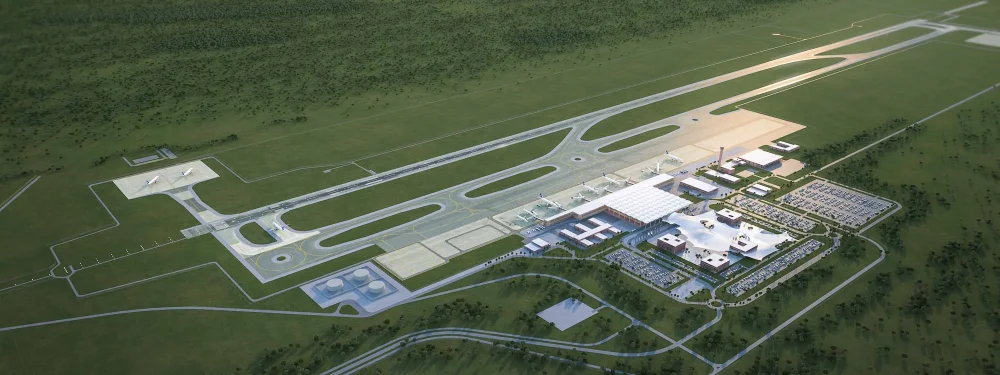
The airport is being developed as a major expansion of Rwanda’s aviation infrastructure and is expected to increase the country’s capacity to handle passenger and cargo traffic as the government seeks to strengthen its position as a regional transport and business hub.
The project is estimated to cost around $2 billion, with Qatar Airways holding a 60% stake in the airport project.
Construction of the airport is also being accompanied by work on the road connecting the facility to the wider road network. The access road is expected to reach 50% completion during the 2026/27 financial year, with more than Rwf3.26 billion allocated for the year.
The funding will support activities including compensation payments, construction works and studies for a proposed toll collection system.
Murangwa said the airport would be among the investments expected to generate economic returns that can help Rwanda service the borrowing used to finance development.
He said Rwanda’s approach to borrowing is based on investing in projects and sectors that can make the economy more productive and generate sufficient resources to meet future debt obligations.
“For semi-concessional borrowing, we build the facility, it becomes productive, and the revenues generated exceed the cost of servicing the loan,” Murangwa said.
He added that the government would not rely primarily on higher taxes to repay its loans, but on a more productive economy capable of generating the resources required when repayment begins.
The IMF has recommended stronger domestic revenue mobilisation and more careful prioritisation of foreign-financed capital expenditure as part of efforts to preserve Rwanda’s fiscal sustainability. It also called for continued fiscal consolidation while protecting social and other priority spending.
Murangwa stressed that fiscal consolidation would not mean halting major development projects, but rather calibrating the pace of investment according to available resources and expected returns.
"It is a matter of calibration, not a stop,” he said when asked whether Rwanda could slow down projects because of tighter external financing.
Rwanda and the IMF reached a staff-level agreement on the first review of the country’s Extended Credit Facility programme after the government met all measurable programme targets for the end of June 2026.
Following approval by the IMF Executive Board, expected in December, Rwanda will have access to about $35.7 million under the programme.
Rwanda’s economy grew by 9.7% in the first half of 2026, while inflation remained elevated at 15.7% in August.
The IMF projects Rwanda’s economy to grow by 7.8% in 2026 and 7.2% in 2027 in real terms.
Loading comments...
Leave a comment