






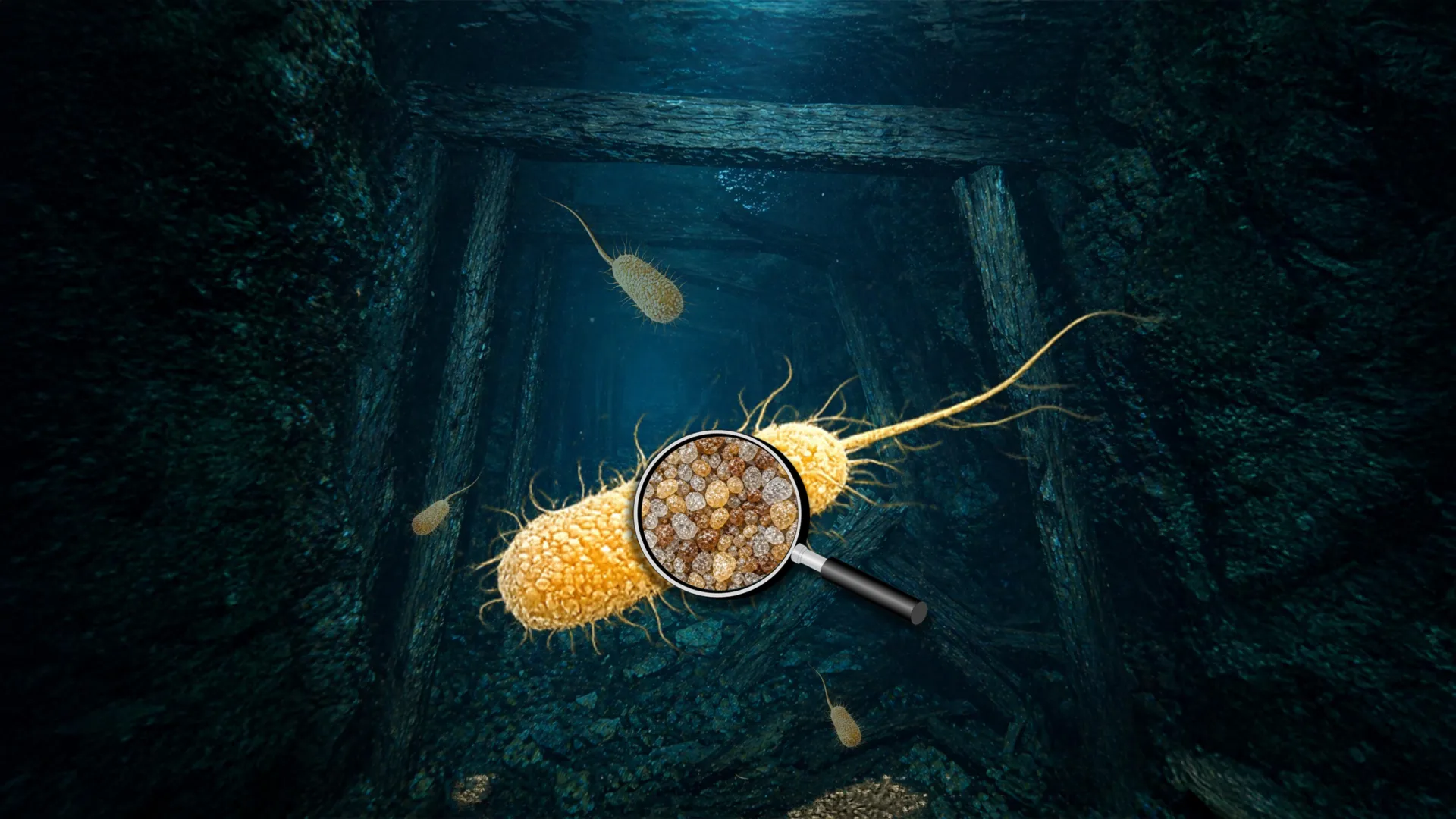
Researchers from the Helmholtz-Zentrum Dresden-Rossendorf, working with Wismut GmbH and the University of Granada, found that bacteria living in uranium contaminated mine water can help remove the metal from water when supplied with glycerol, a substance that serves as a food source for microorganisms.
In laboratory experiments, about 95 percent of the dissolved uranium disappeared from the water within 130 days.
Uranium is a radioactive heavy metal that is normally locked inside minerals in soil. However, mining and other environmental processes can cause it to dissolve and enter groundwater.
Once uranium becomes mobile in water, it can spread through the environment and pose risks because of its toxicity.
The researchers wanted to understand not only whether bacteria could reduce the amount of uranium dissolved in water, but also what happened to the uranium after it was removed.
The team collected water from a flooded uranium mine in Germany's Ore Mountains.
The mine, operated by Wismut GmbH, provided researchers with a naturally occurring community of microorganisms.
In the laboratory, the scientists added controlled amounts of glycerol to samples of the mine water and created oxygen free conditions similar to those found deep underground.
As the bacteria used the glycerol as a food source, the concentration of dissolved uranium gradually fell.
After 130 days, only about five percent of the uranium originally dissolved in the water remained. Further investigation showed that the uranium had accumulated within the bacteria's cell walls.
The researchers then used advanced microscopy and spectroscopy techniques to determine what form the uranium had taken.
Their analysis revealed an unexpected result. A significant amount of the uranium had entered a chemical state known as pentavalent uranium, or uranium with a valency of five.
Pentavalent uranium has generally been considered rare and unstable, with scientists previously viewing it as a temporary chemical state.
The team discovered that the uranium had combined with iron and oxygen to form a compound known as FeU(V)O4.
The compound is particularly interesting because previous research had shown that it could remain stable even when exposed to atmospheric oxygen for more than 25 years.
However, scientists had not previously understood how the compound could naturally form or that bacteria could play a role in its formation.
The new experiments provided another surprise.
When the researchers exposed dried bacterial material containing the uranium compound to oxygen, the amount of FeU(V)O4 actually increased rather than decreased.
This suggests that the compound may be more stable in oxygen rich conditions than previously expected. It also strengthens the possibility that bacterial activity could help transform mobile uranium into a form that is less likely to spread through water.
Dr Evelyn Krawczyk-Bärsch, a scientist in HZDR's Terrestrial Microbiology research group and a co author of the study, said the findings showed for the first time that bacteria supplied with glycerol can convert dissolved uranium into a stable chemical compound.
However, the researchers stressed that more work is needed before the discovery can be turned into a practical method for cleaning contaminated environments.
The scientists now plan to investigate the uranium binding bacteria in greater detail and study the biochemical and geochemical processes responsible for the transformation.
A better understanding of these processes could help determine whether microorganisms can eventually be used as part of efforts to remediate uranium contaminated water and other environments.
Loading comments...
Leave a comment