



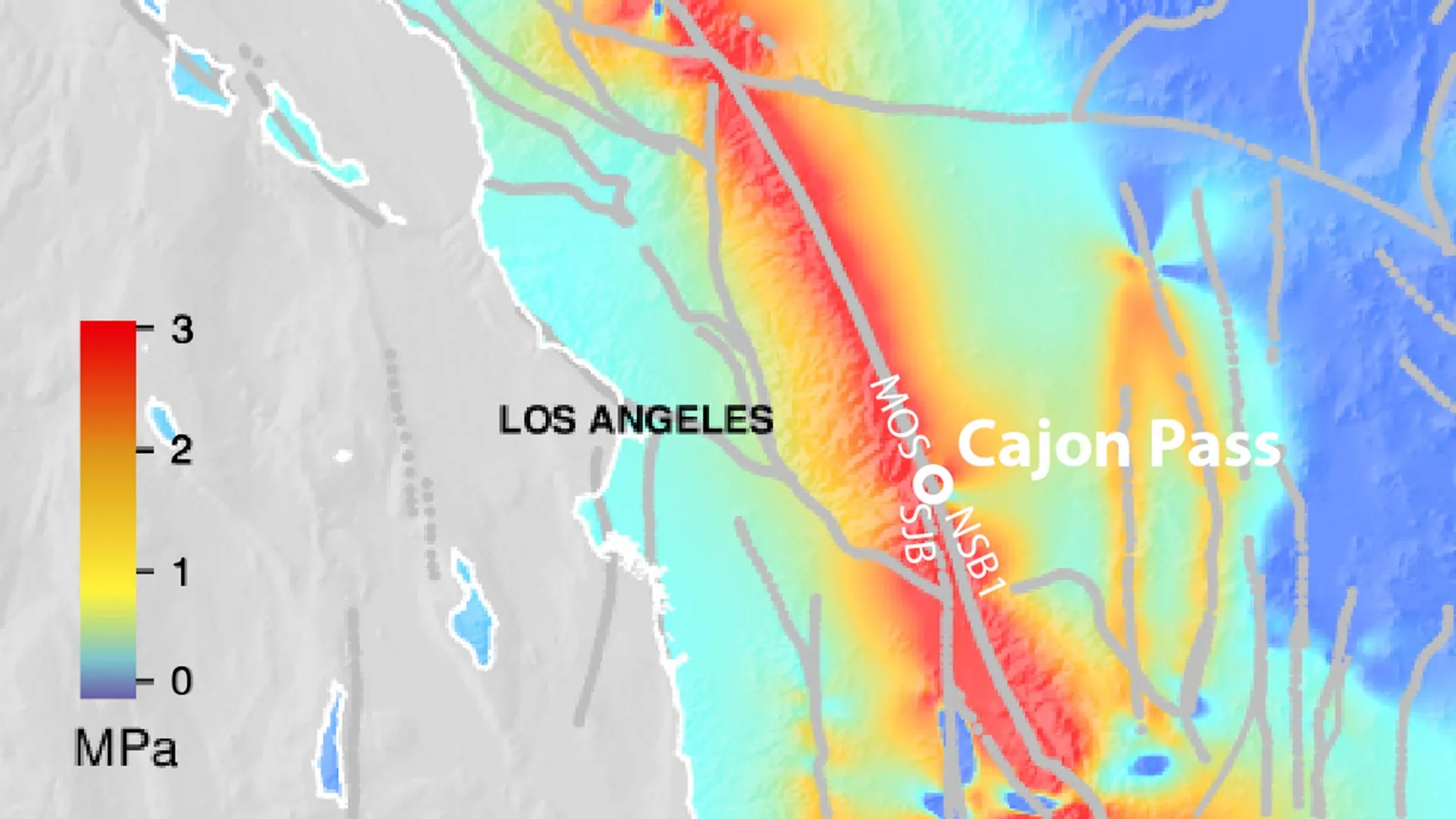
The study, led by Dr Liliane Burkhard of the University of Bern in Switzerland, identifies Cajon Pass, a geological junction northeast of Los Angeles, as a key point that could determine whether an earthquake rupture stops at one fault or continues onto another.
Published in the Journal of Geophysical Research: Solid Earth, the research does not predict when an earthquake will occur. Instead, it examines how accumulated geological stress could influence possible future earthquakes.
The international research team included scientists from the University of Hawaiʻi at Mānoa, the United States Geological Survey’s Earthquake Science Center and the Scripps Institution of Oceanography at the University of California, San Diego.
To understand changes in stress over time, researchers developed a physics-based model simulating approximately 1,000 years of earthquake activity. They combined evidence from radiocarbon dating, tree-ring patterns and historical records of earthquakes that ruptured the ground surface.
The model tracks how earthquakes transfer stress to neighbouring fault sections, how stress accumulates between earthquakes and how deeper layers of the Earth's crust gradually relax after major ruptures.
The findings show that stress on the San Jacinto-Bernardino section has reached 3.6 megapascals, the highest value recorded anywhere in the simulation. Stress on the nearby Mojave South section of the San Andreas Fault reached 2.8 megapascals.
Researchers say the simultaneous high stress on both sections could create conditions more favourable for an earthquake rupture to cross Cajon Pass and affect both fault systems.
Historical earthquakes demonstrate that the junction can behave differently depending on geological conditions. During the magnitude 7.9 Fort Tejon earthquake in 1857, the rupture stopped at Cajon Pass.
However, the 1812 Wrightwood earthquake crossed the junction and ruptured both systems.
A rupture involving both faults could affect a wider area, including greater Los Angeles, San Bernardino, Riverside and the Coachella Valley.
Cajon Pass also contains important highways, railway lines and energy infrastructure.
Burkhard emphasised that high stress does not establish when an earthquake will happen.
The research instead provides information that could support earthquake hazard assessments, infrastructure planning and emergency preparedness.
The researchers say their modelling approach could also help scientists investigate complex fault junctions in other parts of the world.
Loading comments...
Leave a comment