




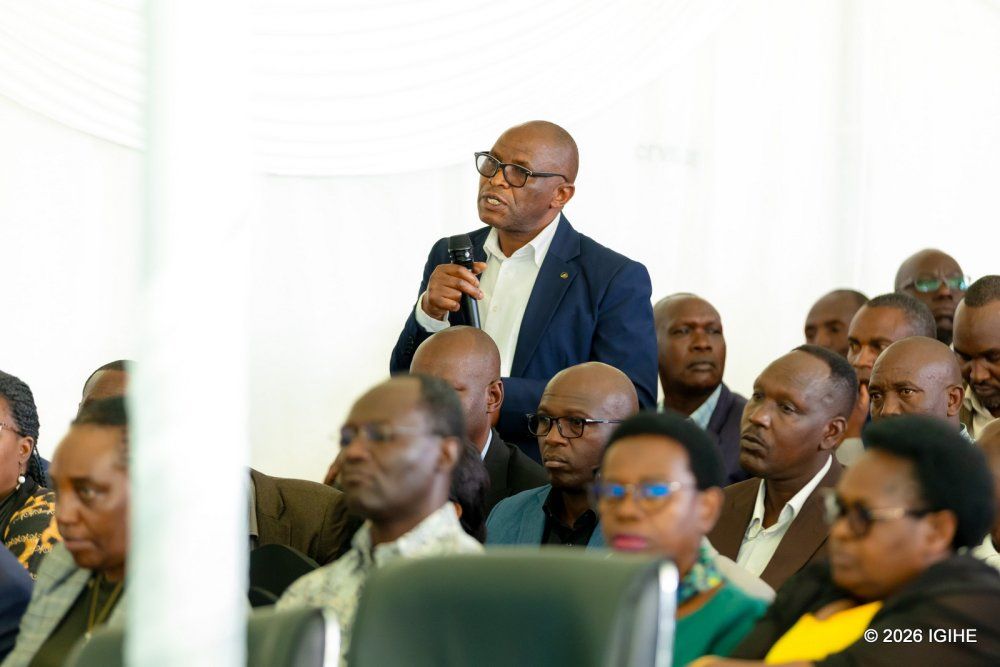
Speaking recently, Senyoni, who currently serves as Secretary of the Rwanda Demobilisation and Reintegration Commission (RDRC), recounted his experience within the military hierarchy during the final years preceding the 1994 Genocide against the Tutsi.
He explained that he joined the former Rwandan Armed Forces in 1984 and later received specialized training abroad in military administration and secretarial services. In 1987, he was assigned to the Secretariat of the Army High Command.
In 1990, after the launch of the liberation struggle by the Rwanda Patriotic Front (RPF), Senyoni was transferred to the military camp in Gako, where he coordinated administrative and financial affairs. As the war intensified, he continued carrying out secretarial duties related to military operations.
By April 1994, Senyoni was still serving in that role and became directly involved in documenting one of the most consequential meetings held after Habyarimana’s plane was shot down on April 6.
“On the evening of April 7, 1994, Bagosora, who was then Chief of Staff at the Ministry of Defence, convened a meeting of senior military officers at the former École Supérieure Militaire, which I believe is now part of UR-CST,” Senyoni recalled.
“Meeting notes were usually taken by hand. The handwritten records from that meeting were brought to the military secretariat, where I typed them before they were forwarded to the Ministry of Defence.”
According to Senyoni, one of the key resolutions adopted during the meeting was the appointment of Bagosora as President to succeed Habyarimana.
“The meeting concluded that Bagosora should become President of the Republic and replace Habyarimana,” he said. “However, when the minutes reached the Ministry of Defence, French military advisers working under military cooperation arrangements reviewed them and warned that if Bagosora became President, the RPF would immediately accuse the military of shooting down the presidential plane and carrying out a coup.”
Senyoni said the French advisers urged military leaders to follow constitutional procedures instead. The officers accepted the advice, effectively ending Bagosora’s ambitions to assume the presidency.
“At that point, they instructed members of the Presidential Guard to bring Théodore Sindikubwabo from Butare,” he said.
Meanwhile, the Genocide against the Tutsi had already begun. Prime Minister Agathe Uwilingiyimana had been killed, along with Joseph Kavaruganda, the President of the Constitutional Court. Violence was spreading rapidly across Kigali.
Under Rwanda’s constitutional arrangements at the time, if the President could no longer perform his duties, the office would pass either to the Prime Minister or the Speaker of Parliament.
Since Uwilingiyimana had already been murdered, Sindikubwabo, who was then Speaker of Parliament, became the constitutional successor. However, he was in Butare, in southern Rwanda.
Senyoni said confusion and divisions within the Presidential Guard complicated efforts to bring him to Kigali.
“The soldiers sent to retrieve him believed he was being brought to Kigali to be killed,” Senyoni said. “They transported him poorly in a pickup truck borrowed from a convent. He was not even wearing socks.”
According to Senyoni, Sindikubwabo arrived at Army Headquarters visibly frightened, convinced he would be killed. However, later that evening, Radio Rwanda announced that he had become President.
“The Genocide continued, and eventually we fled to what is now the Democratic Republic of the Congo. I crossed into Bukavu,” he said.
Senyoni remained in the DRC until 2010, when he decided to return to Rwanda. Three of his five children returned with him and later received educational support from the Imbuto Foundation.
Today, he says he is grateful for the opportunity to serve Rwanda once again. He has spent the past 15 years as Secretary of the RDRC and regularly encourages former combatants still living in eastern DRC to return home.
He emphasized that Rwanda remains open to those willing to reintegrate and urged all Rwandans to continue safeguarding national unity and reconciliation.
Loading comments...
Leave a comment