



His remarks come amid continued calls from the United States urging Rwanda to lift defensive measures deployed along its border with the Democratic Republic of Congo (DRC).
Washington has linked its position to agreements signed between Rwanda and the DRC on June 27, 2025, and again on December 4 of the same year, aimed at addressing insecurity in eastern Congo.
However, Kigali maintains that the DRC has not fully implemented its commitments, particularly regarding the dismantling of the FDLR terrorist group, which Rwanda considers a persistent security threat operating in the region.
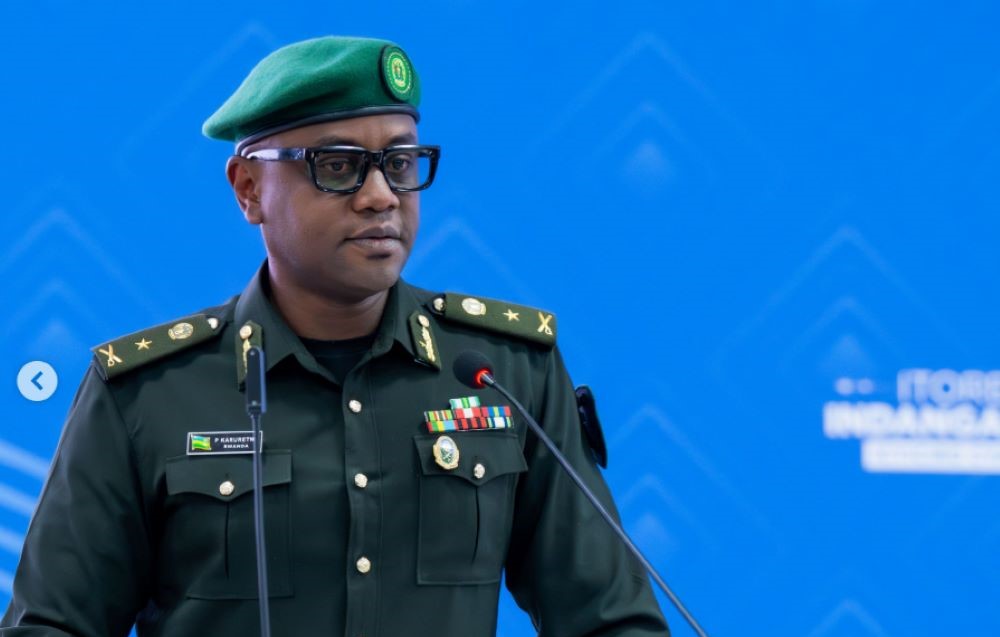
Speaking in an interview with RBA on July 5, 2026, Brig Gen Karuretwa said Rwanda’s current security posture is informed by past experiences, particularly the “Abacengezi” insurgency period, when waiting for threats to reach national borders resulted in severe consequences.
He explained that Rwanda’s approach is based on preventing insecurity before it reaches its territory.
“I referred to the Abacengezi war. Waiting for the enemy to reach our borders and bring their operations onto Rwandan soil is something we have experienced and know the consequences of. We are not poor students of history. Looking at how things unfolded during that period, decisions were taken on how defensive measures should be structured so that citizens can continue to live safely without being affected by threats originating from the DRC,” he said.
The RDF spokesperson added that all states maintain defensive measures tailored to protect national security and respond to evolving threats.
According to Brig Gen Karuretwa, Rwanda’s defensive posture has not remained static but has evolved over time. He noted that even joint operations conducted by Rwanda and the DRC in 2019 to dismantle armed groups were part of earlier defensive arrangements.
However, he said the current situation is different, alleging that elements within the DRC leadership have collaborated with hostile groups, complicating regional security dynamics.
“But when you face a situation like the one we have now, where the President of the DRC has chosen to work with our enemies in ways that bring insecurity from within Congo, defensive measures do not disappear—they change,” he said.
Brig Gen Karuretwa further stated that the FDLR remains a group composed of individuals responsible for the 1994 Genocide against the Tutsi, arguing that the group has continued to maintain hostile intent toward Rwanda.
He also claimed that the group has established structures, including training facilities in areas of eastern DRC such as Walikale and Pinga, which he described as widely known locations.
“Saying we should only focus on those who crossed at that time ignores reality. I do not know whether it is ignorance or deliberate denial. These are well-known facts. The issue of the FDLR has not reduced; it has increased,” he said.
He emphasized that Rwanda will not accept pressure to lift its defensive measures as long as what it considers the root security threat remains unresolved.
“There is no time when pressure on Rwanda has not existed. Defensive measures will remain. They will evolve depending on the situation. If we return to joint operations like those of the past, that would be welcome. But saying we should remove defensive measures entirely—that is not something we will do,” he said.
Brig Gen Karuretwa is also a member of a joint security committee involving Rwanda, the United States, and the DRC, which monitors the implementation of peace agreements. He reaffirmed that Rwanda’s position in these discussions has consistently been guided by what it considers national security realities rather than external pressure.
Loading comments...
Leave a comment