



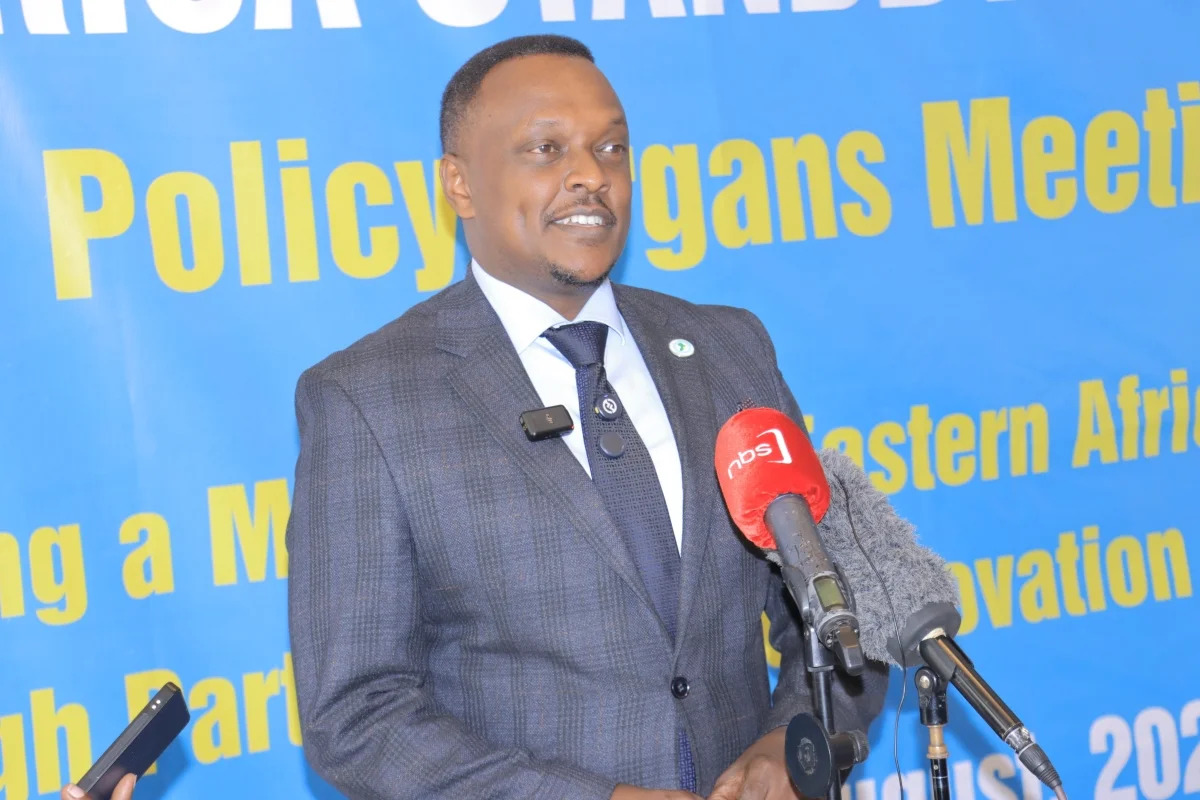
“The most pressing challenges are still terrorism and cross-border crime,” Rwivanga said during an interview with The New Times’ The Context podcast.
The former Rwanda Defence Force (RDF) spokesperson, who took over as Director of the EASF in May, identified Al-Shabaab and other extremist groups among the threats facing the region, noting that insecurity along the eastern coast can disrupt the movement of goods and services.
Regional countries, he argued, need closer cooperation in areas including maritime security and cross-border policing to address threats that transcend national borders.
Testing operational readiness
The EASF has been conducting exercises and force verification missions to ensure member states can deploy the personnel and equipment they have pledged to the regional standby arrangement, Rwivanga explained.
Established in 2004, the EASF is one of the African Union’s five regional standby arrangements. It is mandated to support peace support operations, conflict prevention, crisis response and post-conflict reconstruction in Eastern Africa.
The organisation achieved full operational capability in 2014 after evaluating the forces pledged by member states, according to Rwivanga.
He stressed, however, that readiness is not a one-off process and requires regular exercises and verification.
“We have a checklist to verify the readiness of the forces such that when the need arises for us to engage these forces, we will prove that they are ready for integration,” he noted.
The EASF has conducted command-post, field-training and maritime exercises across member states to strengthen interoperability and ensure that different national forces can operate together.
Rwivanga spoke shortly after a force verification exercise in Uganda, where EASF officials were assessing the country's pledged capabilities.
Similar verification exercises have been conducted in other member states and will continue as part of the organisation's readiness programme, he added.
Beyond military threats
While military preparedness remains central to the EASF's mandate, the organisation is broadening its focus to humanitarian assistance and disaster response, Rwivanga explained.
Member states are increasingly pledging capabilities that can be deployed during natural disasters and other humanitarian emergencies.
Ethiopia has pledged C-130 aircraft for strategic airlift, while Rwanda has committed medical evacuation support and Kenya has pledged air reconnaissance capabilities. Uganda is also expected to contribute search-and-rescue capabilities.
These capabilities could allow the region to respond collectively when a crisis overwhelms the capacity of an individual country, Rwivanga noted.
He pointed to natural disasters and climate-related emergencies as threats that should form part of the region's broader security preparedness.
“We should not just look at the enemy in the sense of rebel forces,” he said. “You should look at the enemy even within with climate-related issues that could easily spiral out of order.”
Reducing reliance on external support
Rwivanga also highlighted efforts by African countries to increase their financial contributions to continental peace and security initiatives.
Greater African funding, he maintained, would help reduce dependence on external partners and strengthen the region's ability to respond to crises.
He pointed to increased contributions by Ethiopia and Kenya to the African Union's peace and security architecture as an indication of growing African ownership.
“At least in our small but very determined way, we are ready to operate even without that external support,” he stated.
The EASF is also seeking greater support from its member states to strengthen its resources and operational capabilities, he added.
Cooperation against cross-border threats
Regional cooperation is essential because terrorism, organised crime and other security threats do not stop at national borders, Rwivanga observed.
He cited joint security engagements between Rwanda and Uganda, as well as Rwanda and Tanzania, as examples of countries working together to address cross-border insecurity.
“Working together helps to deal with all the grey areas, the blind spots along the border,” he said.
He called for stronger cooperation between regional organisations, arguing that economic integration and security cooperation are closely linked.
Disruptions to the movement of goods and services can affect economies on both sides of a border, making security cooperation important not only for defence but also for regional economic activity, he explained.
Ultimately, the EASF's objective is to ensure that member states are prepared to respond collectively when a crisis emerges.
The organisation is seeking to become more cohesive and better prepared to address both traditional security threats and humanitarian emergencies across the region, Rwivanga stressed.
Loading comments...
Leave a comment