



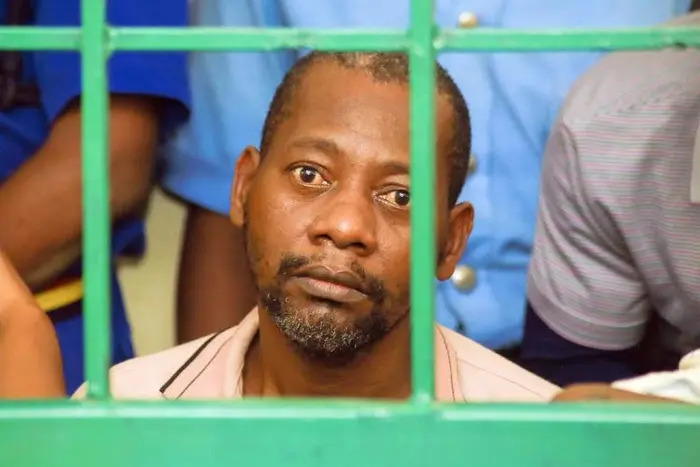
Mackenzie, who led the Good News International Ministries, was convicted alongside 28 accomplices for directing followers to starve themselves and their children to death so they could meet Jesus.
Justice Diana Mochache said Mackenzie bore the primary responsibility for the killings, describing his actions as deliberate and calculated.
"The sentence is appropriate and just, to send an unmistakable message that such atrocities warrant the maximum penalties allowed by law," she said.
The court imposed 100 years in prison for murder by starvation and another 100 years for offences related to direct homicide. The two sentences will run consecutively, bringing his total prison term to 200 years.
The sentences within each category will run concurrently.
Prosecutors had sought the death penalty, arguing that the scale and circumstances of the killings warranted the harshest possible punishment.
However, Justice Mochache declined to impose capital punishment, saying it would eliminate any possibility of rehabilitation. Kenya has not carried out an execution since 1987.
Mackenzie was arrested in 2023 following the discovery of hundreds of bodies in shallow graves in Shakahola Forest, near the coastal town of Malindi.
The investigation shocked Kenya and drew international attention, with more than 400 bodies eventually recovered from the forest. However, the trial and convictions covered 191 deaths.
Twenty-eight accomplices were also convicted for their roles in the killings and received prison sentences ranging up to 160 years.
They included guards who enforced Mackenzie's fasting orders and gravediggers who helped conceal victims' bodies in shallow graves.
The court heard that followers who resisted the instructions to fast were beaten, while children were subjected to prolonged hunger and denied food and water.
Justice Mochache described the killings as cold and calculated, noting that the perpetrators had shown no remorse.
Post-mortem examinations established starvation as the cause of death for most victims, while others died from suffocation, strangulation or head injuries.
Some bodies were too decomposed for the cause of death to be established, while other victims died shortly after being rescued because of severe malnutrition.
Mackenzie and his co-accused had denied the charges, insisting that nobody had been forced to die. His lawyer, Lawrence Obonyo, said the defence would appeal the ruling.
Questions over authorities' response
The Shakahola killings have raised questions about the oversight of religious organisations and the failure of authorities to act on warnings about the cult's activities.
Mackenzie had been on the radar of authorities since 2017, when police searched his premises. His church in Malindi was shut down in 2019, after which he moved to Shakahola Forest and encouraged followers to join him.
Investigations by the Kenya National Commission on Human Rights found that local administration and law enforcement officials had repeatedly ignored warning signs.
Francis Wanje, who lost eight relatives, including two grandchildren, in the tragedy, said he had reported the matter to police in March 2023 but expected authorities to intervene sooner.
He told the BBC that he had hoped Mackenzie would receive a sentence that matched the scale of his crimes.
The discoveries prompted President William Ruto to establish a commission of inquiry and later a task force to review the legal and regulatory framework governing religious organisations.
However, the commission was subsequently declared unconstitutional, while proposed reforms to strengthen oversight have yet to be enacted.
The Kenya Human Rights Commission described the convictions as an important step but called for broader accountability, arguing that local administrators, police, intelligence officers and religious leaders had failed to respond to repeated warning signs.
Mackenzie also faces separate manslaughter and terrorism charges, which he denies.
Although the 200-year sentence marks a major development in the Shakahola case, the fate of hundreds of other victims recovered from the forest remains part of the wider tragedy.
Loading comments...
Leave a comment