



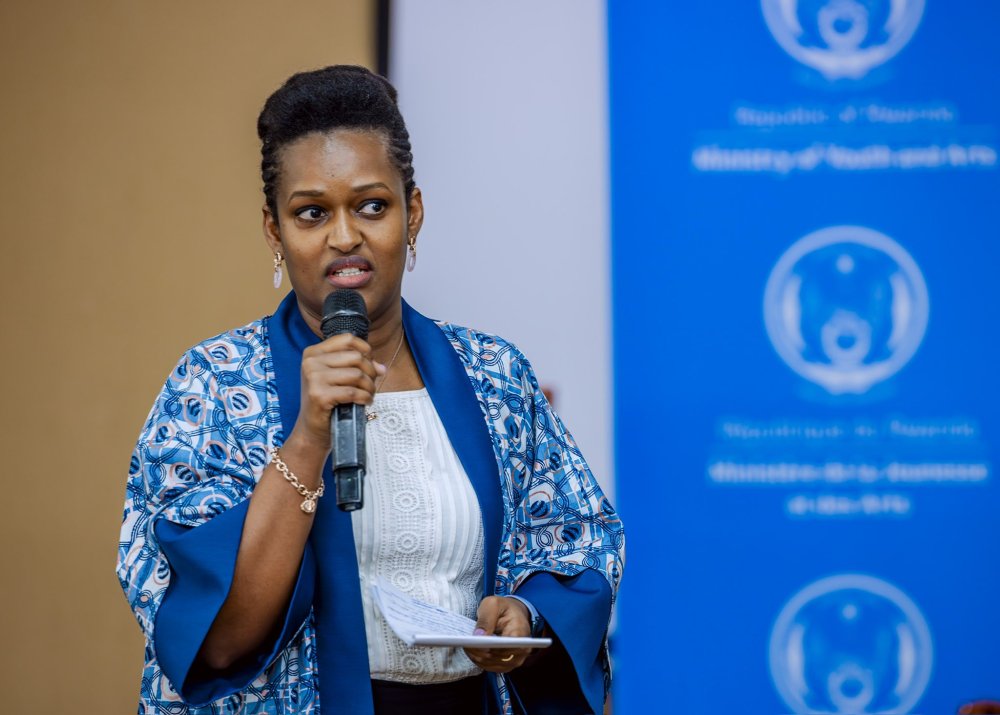
Rwanda’s Minister of State for Youth and Arts, Sandrine Umutoni, has urged young people to critically examine the forces influencing their fashion and dress choices, as debate over decency and dress codes continues to grow.
Umutoni made the remarks amid renewed debate over dress and decency among young people, following an incident at the Diamond Platnumz Experience at the BK Arena Parking Lot on Saturday, August 29, where some attendees, particularly young women, were reportedly stopped from entering over clothing deemed too revealing.
The police action has sparked debate, with some young people describing the enforcement as harassment and questioning the extent to which authorities should regulate personal dress choices.
Rather than reducing the debate to whether the State is attempting to control people’s bodies, Umutoni said there was a need to examine the wider forces influencing fashion trends.
“I have been reflecting on the debate around how some of our young people dress, and I wonder whether we are asking ourselves the deeper questions,” she said in a social media post on Sunday.
“When concerns are raised about increasingly revealing fashion trends, the conversation quickly becomes: ‘Why does the State want to police our bodies?’ But perhaps we should also ask: who is shaping these trends in the first place, and why?”
Umutoni said young people, particularly girls, are increasingly exposed to messages linking appearance and femininity with displaying the body, arguing that such ideas are reinforced through fashion, advertising, music, films, music videos and social media.
She, however, stressed that the debate should not be framed as an indictment of women’s bodies or as an argument that women and girls are responsible for managing other people’s sexuality.
“This is not an argument that the female body is inherently provocative. It is not. Nor should women and girls be made responsible for managing other people’s sexuality by simply being told to cover themselves,” she stressed.
Instead, she questioned why the female body is so frequently commodified by cultural and commercial industries.
Umutoni also linked the discussion to cultural identity, saying Rwanda should consider how it can develop a contemporary fashion identity rooted in its own culture while remaining open to global influences.
She pointed to Nigeria as an example of a country where traditional fabrics, patterns, craftsmanship and aesthetics have been incorporated into contemporary fashion.
“What does contemporary Rwandan fashion look like when it is confident enough to draw from who we are, while remaining creative, youthful and open to the world?” she asked.
According to Umutoni, embracing local cultural influences does not mean prescribing one way of dressing or rejecting foreign influences.
“Culture has always evolved. The question is whether we are participating in that evolution as creators, or simply consuming what others create for us,” she noted.
Her comments come against the backdrop of a broader push by authorities to address what they consider indecent behaviour and misconduct among young people.
In a joint press briefing on August 8, 2026, Rwanda National Police spokesperson ACP Boniface Rutikanga warned that authorities would not tolerate public nudity, indecent dressing, disorderly conduct or sexually explicit content.
Rutikanga said personal freedoms have limits when they conflict with public order and cultural norms.
“We will not continue to tolerate indecent conduct, disorderliness or people exposing themselves… under the excuse that they are young and modern. We do not want that dirt… Rights have limits,” he said.
Police have also warned owners and managers of bars, nightclubs and event venues that they could be held legally responsible for indecent behaviour, underage drinking and reckless conduct occurring on their premises.
Authorities further announced increased monitoring of social media platforms, particularly TikTok, targeting content deemed sexually explicit or indecent.
Police cited Article 143 of Rwanda’s Penal Code, which criminalises public indecency and provides for a prison sentence ranging from six months to two years.
For Umutoni, however, the conversation should extend beyond enforcement and focus on whether young people understand the cultural and commercial forces shaping what they perceive as fashionable or desirable.
She urged both young women and men to question the trends presented to them and consider who benefits from them and who defined them as desirable.
“Freedom is not only the ability to choose. It is also the ability to understand what is shaping our choices, and the confidence to create alternatives of our own,” Umutoni remarked.
Loading comments...
Leave a comment