




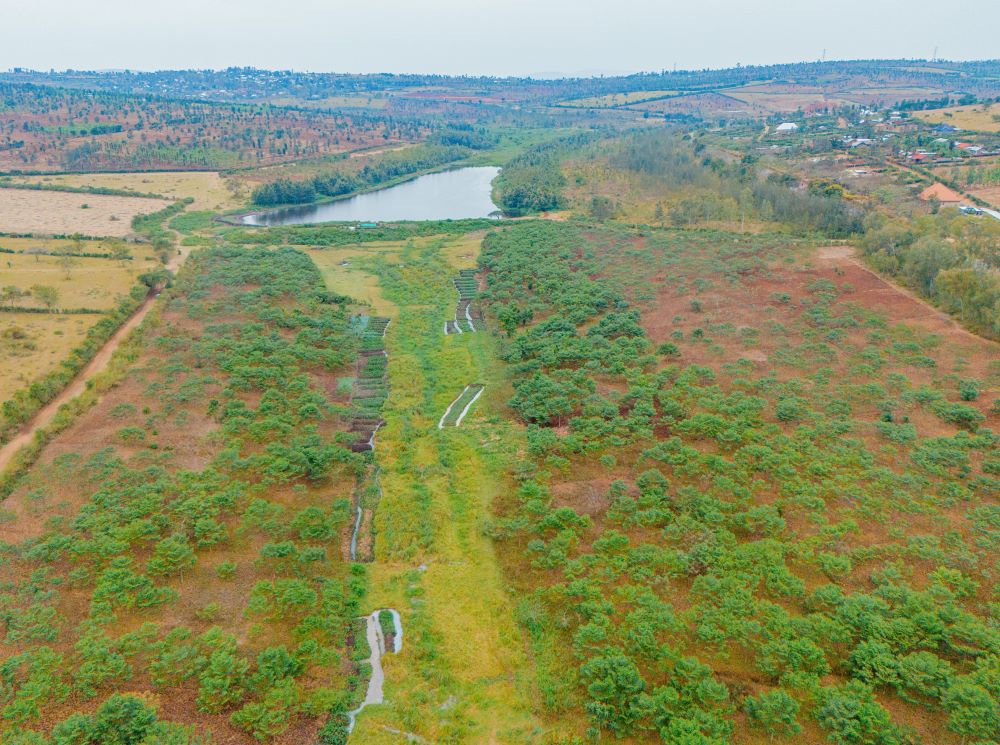
Nearby, young native trees planted along a stream now form a dense green corridor, while a once-deep gully has been stabilized with trees and grasses through years of community effort.
For these farmers, such activities have become part of their daily routine: tree planting, riverbank protection, construction of infiltration trenches, terrace maintenance, and monitoring of erosion-prone zones.
They engage in these efforts with the awareness that their prosperity and health are closely tied to well-conserved ecosystems.
Their contributions extend beyond their own livelihoods, benefiting multiple sectors, including private enterprises that depend massively on natural resources such as water, forests, mining, and secure infrastructure.
Yet despite the value of their work, their environmental contribution remains largely uncompensated.
This is where the idea of Payment for Ecosystem Services (PES) offers a different future.
PES is an approach in which those who benefit from protected and conserved environmental services compensate those who restore, protect, conserve and maintain the ecosystems.
Different companies including beverage manufacturers as well as water treatment facilities and financial institutions, all depend on secured infrastructure, stable and clean water sources originating in rural watersheds.
When upstream landscapes are well protected, the benefits are immediate. Forests, wetlands, and terraced hillsides slow runoff, reduce erosion, and regulate river flow. Water arrives cleaner and more stable, lowering treatment costs and improving reliability.
But when these landscapes degrade, sediment fills rivers and reservoirs, infrastructure is damaged, and treatment plants spend more on chemicals, energy, and maintenance. The costs are ultimately passed through the economy.
Environmental economists often describe farmers as “hidden water managers,” because much of this protection work happens far from the industries that depend on it.
Consider cooperatives of smallholder farmers working in the upper Akagera and Nyabarongo catchments.
Over time, they have restored degraded slopes, planted millions of native trees, stabilized riverbanks, and rebuilt terraces that prevent soil loss. These actions significantly reduce sediment flowing downstream and improve overall water quality.
Under a fully implemented PES system, these activities would no longer be treated as voluntary conservation efforts alone. They would be recognized as measurable services with direct economic value.
Water treatment plants would spend less on purification. Beverage companies would benefit from more reliable and higher-quality water.
Cement and manufacturing industries would face fewer disruptions linked to flooding or sedimentation. Financial institutions financing green growth would have stronger environmental resilience in their investment portfolios.
A portion of these savings and benefits would be redirected back to the communities responsible for protecting and conserving watershed health.
The result would be a structural shift in how environmental protection is financed. Instead of relying mainly on donor projects or government programs, conservation would become a self-sustaining economic system.
Farmers would earn income from ecosystem stewardship, while companies would invest directly in securing the natural systems that underpin their operations.
Across Rwanda, thousands of hectares have already been restored through terracing, reforestation, and riverbank protection. However, sustaining these gains requires continuous labor and long-term incentives. Without them, conservation improvements can gradually weaken.
PES addresses this challenge by turning environmental protection into an economic asset rather than a cost. A brewery dependent on clean water has a direct financial interest in upstream watershed protection.
A water utility benefits when sediment levels decline. A cement factory benefits when flood risks decrease. Even banks financing infrastructure and agriculture gain from improved environmental stability.
In this system, upstream communities are no longer passive recipients of environmental aid. They become active providers of services that sustain national development.
Farmers planting native trees along tributaries of the Nyabarongo River help protect water quality for industries they may never directly interact with.
Cooperatives maintaining terraces in the upper Akagera reduce erosion that would otherwise affect infrastructure dozens of kilometers away.
Communities protecting riverbanks along the Nyabugogo contribute to the resilience of entire watersheds.
Their work creates continuous, measurable value. The question, then, is not whether this value exists, but whether it should remain unrecognized. In a fully functioning PES system, it would not.
Farmers maintaining restored gullies or cooperatives protecting riverbanks would be seen not only as agricultural communities but as environmental service providers supporting water security, economic productivity, and climate resilience. Their contributions would be formally acknowledged and compensated.
The broader impact would extend across society. Rural incomes would improve. Conservation efforts would become more sustainable. Water quality across major river systems would increase. Businesses would reduce operational risks and costs. Watersheds would become more resilient to climate change impacts such as intense rainfall and prolonged dry periods.
In a future shaped by Payment for Ecosystem Services, every tree planted, every terrace maintained, every riverbank protected, and every gully restored would represent more than conservation. It would represent a functioning partnership between communities, business, and nature, one where those who protect Rwanda’s natural resources are finally acknowledged and compensated for the essential services they provide.
About the writer
Jean Claude Habimana is a science communication expert specializing in nature-based solutions, One Health, clean water, renewable energy, sustainable agriculture, gender and youth development, food systems, biotechnology, the circular economy, and policy brief development.
Loading comments...
Leave a comment