



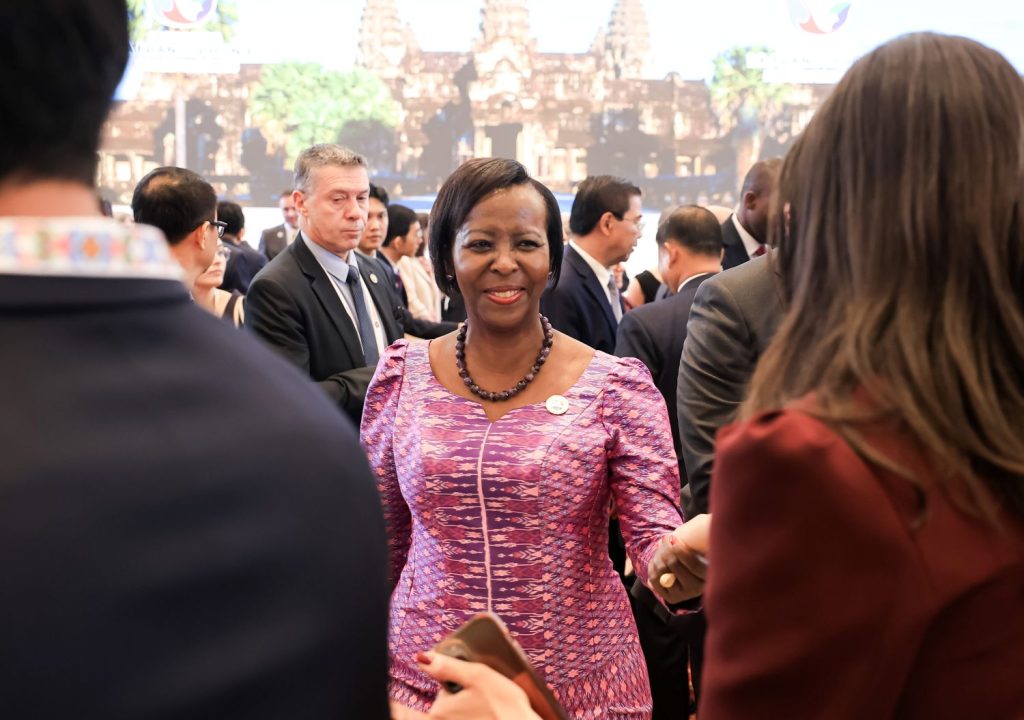
The decision was taken during the 20th Francophonie Summit in Phnom Penh, Cambodia, where leaders held closed-door discussions on the election of the organisation's next Secretary-General.
Mushikiwabo, who was seeking a third term after first taking office in 2018, will continue leading the organisation during the one-year extension, after which a fresh election will be held.
Three candidates had remained in the race: Mushikiwabo, who was nominated by Rwanda, former Romanian Prime Minister Dacian Cioloș and former Mauritanian minister Coumba Bâ.
However, discussions among member states became deadlocked, with two opposing positions emerging. One group favoured proceeding with an election, while another pushed for consensus on a candidate before a decision could be made.
The disagreement also exposed differences over how the organisation should select its Secretary-General following recent changes to its rules.
The revised provisions favour an election in which each member state has one vote, replacing the previous approach that relied on consensus.
French President Emmanuel Macron left the closed-door discussions before an agreement was reached. Speaking to Africa 24, he said he had presented his views to fellow leaders but saw "no chance whatsoever of success".
Diplomatic pressure over Mushikiwabo's candidacy
The deadlock followed diplomatic manoeuvring over the candidates, including reported efforts by Macron to have Mushikiwabo withdraw in favour of Cioloș.
The Democratic Republic of Congo (DRC) withdrew its candidate, Juliana Amato Lumumba, on November 14, 2026, and backed Cioloș, reshaping the contest ahead of the summit.
In a November 13 report, Jeune Afrique revealed that Macron had written to President Paul Kagame proposing Mushikiwabo's withdrawal in favour of Cioloș, reportedly assuring him that the DRC and Mauritania would also withdraw their candidates.
Similar overtures were reportedly made to the DRC and Mauritania.
Rwanda, however, rejected the proposal, insisting that no country had the right to dictate another member state's choice of candidate.
"Rwanda is not a country that takes orders from another country, no matter how wealthy that country may be. No country has the right to tell another country that has nominated a candidate to withdraw that candidate," Foreign Affairs Minister Olivier Nduhungirehe told Rwanda Broadcasting Agency (RBA).
He added: "Those days when one country thought it could make decisions for everyone in the Francophonie are over."
The postponement means Mushikiwabo will remain at the helm while member states seek a way to resolve the disagreements and prepare for a new election.
Meanwhile, Canada has been selected to host the 21st Summit of Heads of State and Government of the OIF in 2028, with the meeting scheduled to take place in Ottawa.
Canada had expressed interest in hosting the gathering in December 2025, before Foreign Affairs Minister Anita Anand formally submitted the country's bid to the OIF in March 2026.
Loading comments...
Leave a comment