



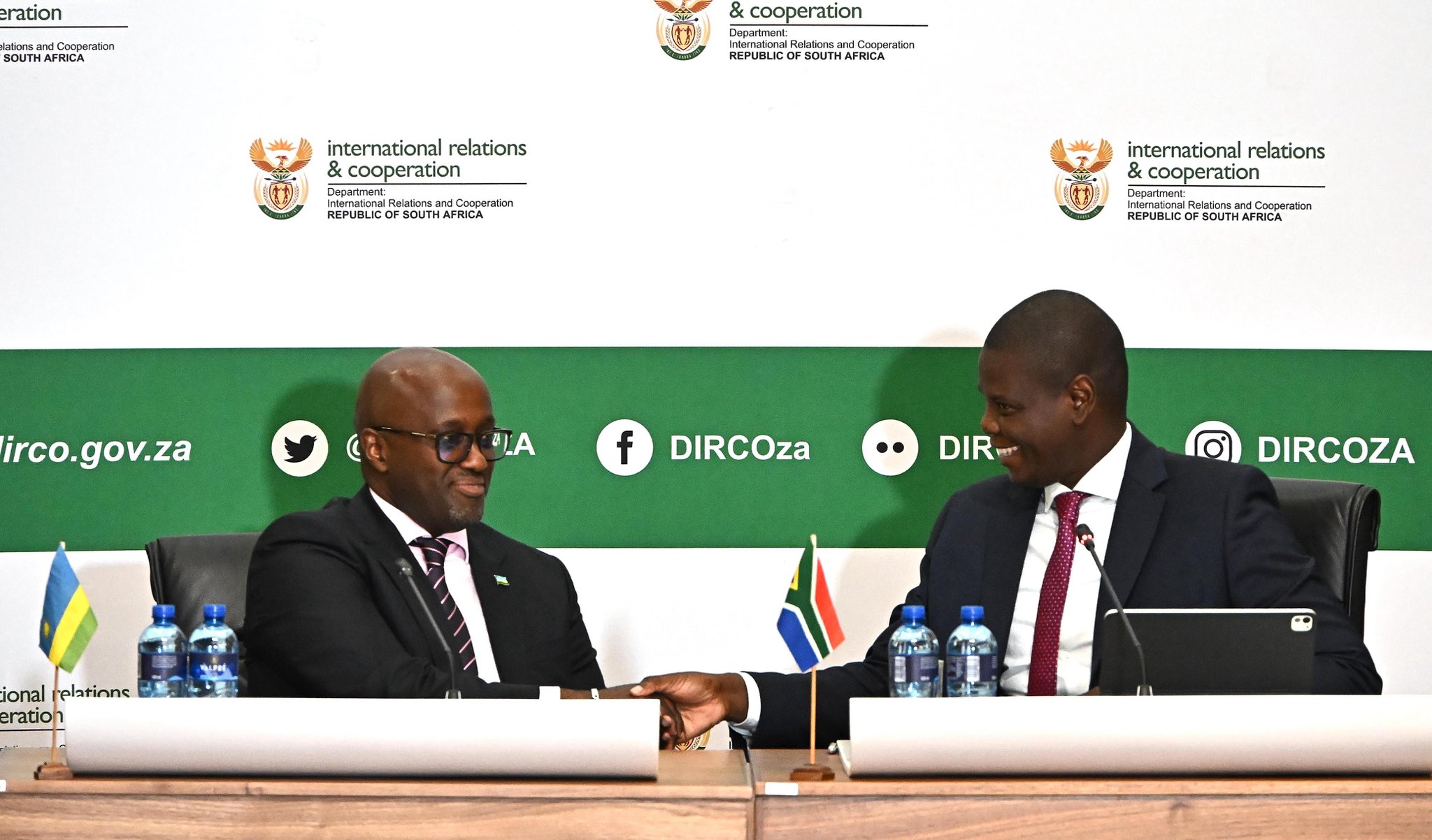
The commitment was announced on Wednesday following bilateral talks in Pretoria between Rwanda's Minister of Foreign Affairs and International Cooperation, Olivier Nduhungirehe, and South Africa's Minister of International Relations and Cooperation, Ronald Lamola.
The decision forms part of a broader roadmap agreed by the two governments to restore full bilateral cooperation, expand trade and investment, strengthen political dialogue and deepen collaboration across multiple sectors.
"The facilitation for South Africa to lift visa restrictions for qualifying holders of ordinary Rwandan passports represents a significant confidence-building measure and a tangible expression of our commitment to restoring normal bilateral relations with Rwanda," Lamola said after the talks.
He said the move is expected to stimulate trade and investment, promote tourism, expand scientific and technological cooperation and strengthen people-to-people exchanges.
For Rwanda, the announcement represents one of the most tangible outcomes since both governments began efforts to rebuild relations.
Nduhungirehe welcomed the agreement, describing it as another important milestone in restoring ties between the two countries.
"In particular, Rwanda welcomes the commitment to facilitate issuance of visas to holders of ordinary Rwandan passports within 12 months," he stated.
"This measure will help strengthen people-to-people ties, promote business and tourism exchanges and further deepen the friendship between our peoples."
South Africa suspended the issuance of visas to Rwandan citizens holding ordinary passports on March 10, 2014, following a sharp diplomatic fallout that also saw both countries expel diplomats from each other's capitals.
Since then, ordinary passport holders have faced major restrictions in travelling to South Africa, while visa exemptions largely remained limited to holders of diplomatic and service passports.
The diplomatic crisis stemmed from Rwanda's accusations that South Africa was providing sanctuary to individuals involved in activities aimed at destabilising Rwanda, including attacks launched from South African territory.
Pretoria, in turn, accused Rwandan diplomats of involvement in an attack on the residence of former Rwanda army chief Kayumba Nyamwasa, allegations Kigali denied.
Resetting relations
Both ministers described Wednesday's meeting as a major step toward turning the page on years of strained relations.
Lamola said Presidents Cyril Ramaphosa and Paul Kagame have demonstrated a shared commitment to rebuilding ties.
"Our two heads of state share a profound and deep commitment to reset and re-energise our bilateral relations," he noted.
"The normalisation of relations assumes great significance. This visit provides an opportunity to consolidate the progress made thus far, address outstanding issues through constructive dialogue and chart a path towards a more stable and mutually beneficial partnership."
Nduhungirehe said Rwanda was approaching the discussions "in a spirit of openness, goodwill and partnership."
"Today's meeting reflects the commitment of our heads of state to open a new chapter in Rwanda-South Africa relations," he said.
"It demonstrates our shared belief that dialogue, mutual respect and constructive engagement are the best way to address differences and strengthen cooperation."
He added that Rwanda believes "the bond between Rwanda and South Africa is unbreakable," despite challenges experienced over the past decade.
Wide-ranging cooperation
Beyond the visa breakthrough, both governments agreed to significantly expand cooperation across a broad range of sectors.
A joint declaration issued after the talks outlines plans to strengthen collaboration in nature and wildlife conservation, tourism, hospitality, health, science and technology, higher education, research and development.
The two countries also committed to increasing cooperation in trade, infrastructure development, innovation, agriculture, digital technology and investment while encouraging greater participation in exhibitions, business forums and international conferences hosted in both countries.
The ministers agreed to revive the Joint Commission for Cooperation (JCC), which has not convened since 2007, to oversee implementation of bilateral agreements and identify new areas of collaboration.
Senior officials will immediately begin preparing work plans and reviewing existing agreements while negotiating new frameworks for cooperation.
The declaration also commits both governments to facilitate business, tourism, academic exchanges and broader people-to-people contacts, institute mechanisms for the exchange of relevant personnel to support visa issuance, and use diplomatic channels to resolve issues of mutual concern.
Regional security and continental issues
Regional peace and security also featured prominently during the discussions.
The ministers exchanged views on the security situation in eastern Democratic Republic of Congo, Cabo Delgado in Mozambique, Sudan, South Sudan, Somalia and the Sahel, while calling for peaceful resolution of conflicts through dialogue and mediation.
They emphasised the need to strengthen Africa's peace and security architecture, including accelerating the operationalisation of the African Standby Force.
The two governments also reaffirmed support for South Africa's leadership of the African Union's C5 High-Level Advocacy Committee on South Sudan and expressed concern over the deteriorating political and security situation in the country.
On global affairs, both ministers called for reform of international governance institutions, including the United Nations Security Council, arguing that Africa and the Global South deserve greater representation in global decision-making.
Presidents to meet
The ministers agreed to maintain regular consultations and convene the next session of the Joint Commission for Cooperation during the first quarter of 2027.
They also confirmed that Presidents Kagame and Ramaphosa will hold a bilateral meeting at a mutually agreed date through diplomatic channels.
Lamola said the planned summit would be "another powerful affirmation that South Africa and Rwanda have reaffirmed the strong bonds of friendship, solidarity and cooperation."
Nduhungirehe said Rwanda was leaving Pretoria encouraged by the progress made.
"We remain committed to sustaining the positive momentum generated by this engagement," he concluded.
"We are confident in the future of the relations between our two countries."
Loading comments...
Leave a comment