



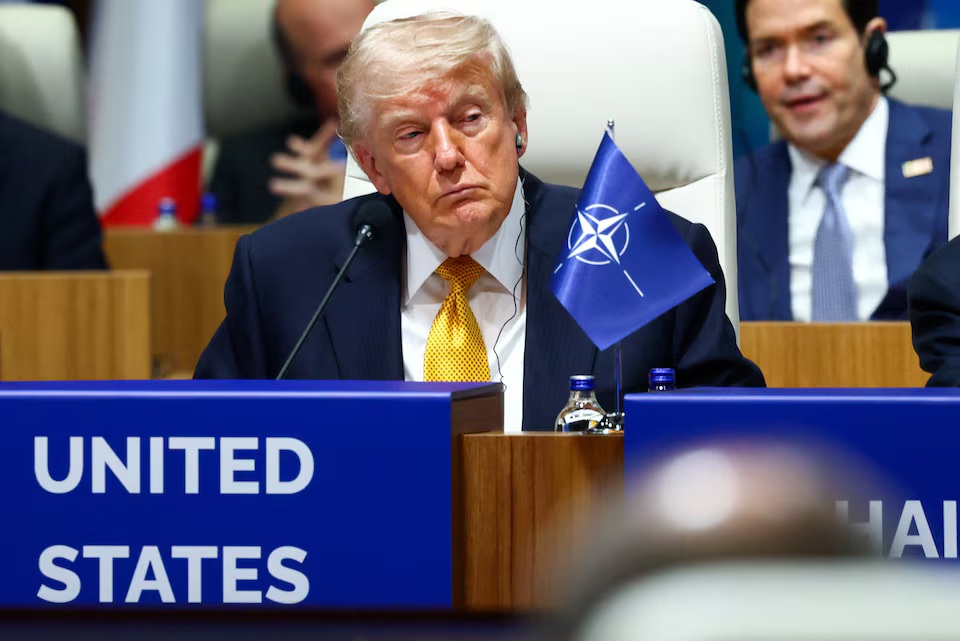
Speaking at the NATO summit in Ankara, Trump described Spain as a "terrible partner" and instructed Treasury Secretary Scott Bessent to stop all trade with the country, escalating a dispute over Madrid's opposition to NATO's new defence spending target of 5% of gross domestic product (GDP).
"I don't want to do any trade with them, alright?" Trump said before turning to Bessent, who replied, "Yes, sir."
Trump then added: "Take it immediately. Don't even talk to them. They're hopeless. They're bad people … They make so much money with us, and we're going to see that they make a lot less."
The comments marked the second time Trump has publicly directed Bessent to halt trade with Spain. He made a similar threat in March after Madrid rejected higher military spending targets, although trade between the two countries continued uninterrupted.
European leaders had hoped the summit would showcase NATO unity, stronger support for Ukraine and increased defence commitments. Instead, Trump's remarks reignited tensions within the alliance over military spending, the Iran conflict and broader transatlantic relations.
Trump has repeatedly criticized Spain after Prime Minister Pedro Sanchez refused to allow the United States to use Spanish airspace and military bases during the Iran war. Washington and Madrid jointly operate two major military bases in southern Spain that support U.S. naval and air operations.
"Spain doesn't agree to anything, and you shouldn't carry them," Trump told NATO Secretary General Mark Rutte during the summit.
Rutte sought to ease tensions, noting that Spain had increased defence spending to 2% of GDP last year but acknowledged "there are still issues we have to solve."
Spain dismissed Trump's latest comments, with Sanchez's office describing them as "business as usual" and insisting bilateral relations with Washington remained "excellent."
The Spanish government also noted that Spain runs a trade deficit with the United States and stressed that, as part of the European Union's customs and trade union, individual member states cannot negotiate separate trade arrangements with Washington.
Spanish Health Minister Monica Garcia was more critical, writing on X that Spain was "a sovereign, democratic country that defends multilateralism and peace."
"What's terrible is confusing diplomacy with bullying," she said.
Trump also widened divisions within NATO by renewing his demand that the United States should control Greenland, the semi-autonomous Danish territory that has become a recurring point of contention with Copenhagen.
"Greenland is very important for the United States, but it's not important for Denmark," Trump said, arguing that Washington should have retained control of the island after World War II.
Danish Prime Minister Mette Frederiksen rejected the suggestion, saying: "We are ready to defend every inch of NATO, including our own territory."
Trump's remarks extended beyond Europe, with the U.S. president declaring that a fragile ceasefire with Iran was effectively over following fresh American strikes and accusing Tehran of violating the truce.
"It's over. I don't want to deal with them," Trump said. "They're scum. They're sick people. They're led by sick people."
Rutte defended the U.S. military response against Iran and praised Trump for pushing European allies to spend more on defence.
"I think what you did last night was absolutely necessary. It was a very strong response," Rutte said, adding that Trump's pressure had helped European countries "raise their game" on military spending.
Despite Trump's threats, analysts say it would be difficult for the United States to single out Spain for trade restrictions because trade policy with EU member states is negotiated collectively by Brussels rather than individual governments.
Meanwhile, major U.S. investors continue to view Spain positively. BlackRock recently identified Spain as its preferred market for equity exposure, citing stronger economic growth than most developed economies, even as overall U.S. investment in Spain declined during the first quarter of 2026.
Spain exports products including olive oil, auto parts, steel, chemicals and wine to the United States, although economists say its economy is less exposed to potential U.S. trade retaliation than several other European countries.
Loading comments...
Leave a comment