



Developing countries remain underrepresented in key bodies shaping global security, finance, trade and emerging technologies. So who gets to write the world’s rules?
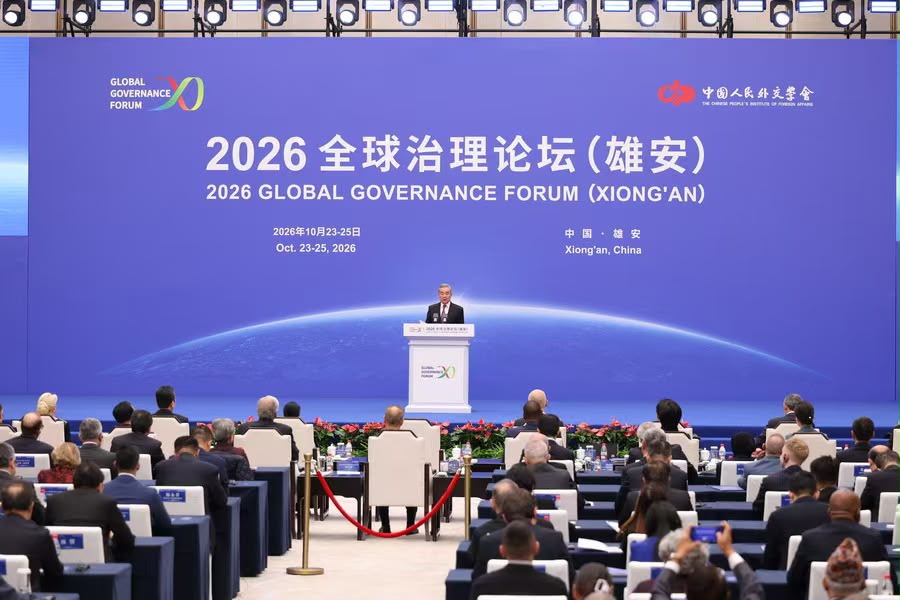
That question ran through the three-day 2026 Global Governance Forum in Xiong’an, where more than 450 proposals emerged from 22 discussions across five thematic sections, with participants from 97 countries and international organizations.
The forum was held in Xiong’an New Area, Hebei Province in northern China, about 100 kilometres southwest of Beijing.
Established in 2017, Xiong’an was created partly to accommodate functions transferred from Beijing that are not essential to its role as China’s capital.
Nearly 400 participants gathered to debate UN reform, international trade and finance, artificial intelligence, climate change, cyberspace and outer space before the forum closed on October 25.
The central argument was that the Global South’s growing demographic and economic weight should be reflected more strongly where international rules are written.
The forum provided “a valuable platform for countries and various sectors, in particular the Global South, to participate in international governance on an equal footing and make their voices heard,” Chinese People’s Institute of Foreign Affairs President Wu Ken said.
“It carried out fruitful and valuable explorations to advance global governance from ‘elite consensus’ to ‘all-round collaboration’, and from ‘forum dialogue’ to ‘long-term cooperation networks’,” he said.
54 African countries, zero permanent seats
The imbalance is particularly visible at the United Nations.
The UN has 193 member states, but its Security Council has only 15 seats — five permanent and 10 elected.
Africa accounts for 54 UN members and around 1.5 billion people, yet has no permanent Security Council seat.
The five permanent seats remain with China, France, Russia, the United Kingdom and the United States.
That gap illustrates a central Xiong’an argument: membership does not necessarily mean equivalent decision-making power.
The Global Governance: Xiong’an Vision therefore calls for greater Global South participation in international rule-making, agenda-setting and decision-making.
Wu said the forum had “consolidated international consensus and public support for reforming and improving global governance.”
$34.65 trillion in trade — but who writes the rules?
The same contradiction appears in the global economy.
The World Trade Organization (WTO) has 166 members. In 2025, world merchandise trade was worth $26.26 trillion, while commercial services trade reached $9.56 trillion. Combined global trade in goods and services reached $34.65 trillion.
Developing economies are already major players in that system. By 2024, they accounted for $48 out of every $100 of global merchandise exports, up from $38 out of every $100 in 2006.
Their share of global commercial services exports also rose from about $25 to $33 out of every $100 over the same period.
Trade among developing economies themselves had reached $6.1 trillion in 2022, nearly one-quarter of global trade, compared with less than one-tenth in 1995.
Yet the Xiong’an discussions argued that growing economic weight has not automatically translated into equivalent influence over global trade and financial governance.
The Xiong’an Vision calls for WTO reform addressing digitalization, green development and countries at different development stages.
It also urges Global South countries to coordinate their positions when international economic and trade rules are formulated.
The distinction is crucial: having a large market is economic weight; helping determine its rules is institutional power.
2.2 billion offline as AI rules are written
Artificial intelligence risks reproducing that imbalance.
Around 6 billion people were online in 2025, while approximately 2.2 billion remained offline. More than 2.1 billion of those without internet access live in low- and middle-income economies, according to International Telecommunication Union figures.
That raises another question: can countries facing basic connectivity and investment gaps participate equally in writing the rules for AI?
The Xiong’an Vision proposes the UN as a central platform for AI governance and calls for wider access to technology, research and expertise, alongside safeguards against malicious use and technological monopolies.
A $4 trillion development gap
Finance reveals another divide.
Developing countries face an estimated $4 trillion annual financing gap to achieve the Sustainable Development Goals, including around $2.2 trillion linked to the energy transition.
Around 3 billion people also live in countries where governments spend more on debt interest than on health and education combined.
Those figures turn global governance from an abstract debate into questions about hospitals, schools, electricity and infrastructure.
The forum called for faster implementation of the 17 SDGs, reform of international financial governance and greater financial and technological support for developing countries.
For Wu, proposals alone were not enough.
The forum had “accelerated the translation of core concepts of the Global Governance Initiative from consensus into action,” he said.
China announced eight practical actions covering areas including UN reform, AI capacity-building, human rights, marine biodiversity and outer-space governance, alongside plans for a Global Governance Research Center.
“Multiple institutions released research reports, established dialogue mechanisms and launched cooperation projects,” Wu said.
From blueprint to 5,345 buildings
Xiong’an itself offered a physical example of turning plans into results.
Nine years after its establishment, the area has more than 58 million square metres of building floor area and 5,345 newly constructed buildings.
More than 400 new branches of state-owned enterprises and over 4,000 Beijing-origin enterprises have established operations there, while four universities and two hospitals are under construction.
“Participants agreed that the experience and achievements of Xiong’an could inform solutions for global governance and can be of valuable reference,” Wu said.
Yet changing a skyline may prove easier than changing institutions built over generations.
Africa has 54 UN members but no permanent Security Council seat; developing countries face a $4 trillion annual SDG financing gap; and 2.2 billion people remain offline as AI rules are being debated.
Those gaps capture the argument emerging from Xiong’an: the Global South’s numerical and economic weight does not yet translate proportionately into rule-making power.
And that leaves one question: Who writes the world’s rules?
For the Global South, the test is whether its billions of people and growing economic weight can secure not merely a seat at the table, but a meaningful hand in writing the rules.
Loading comments...
Leave a comment