



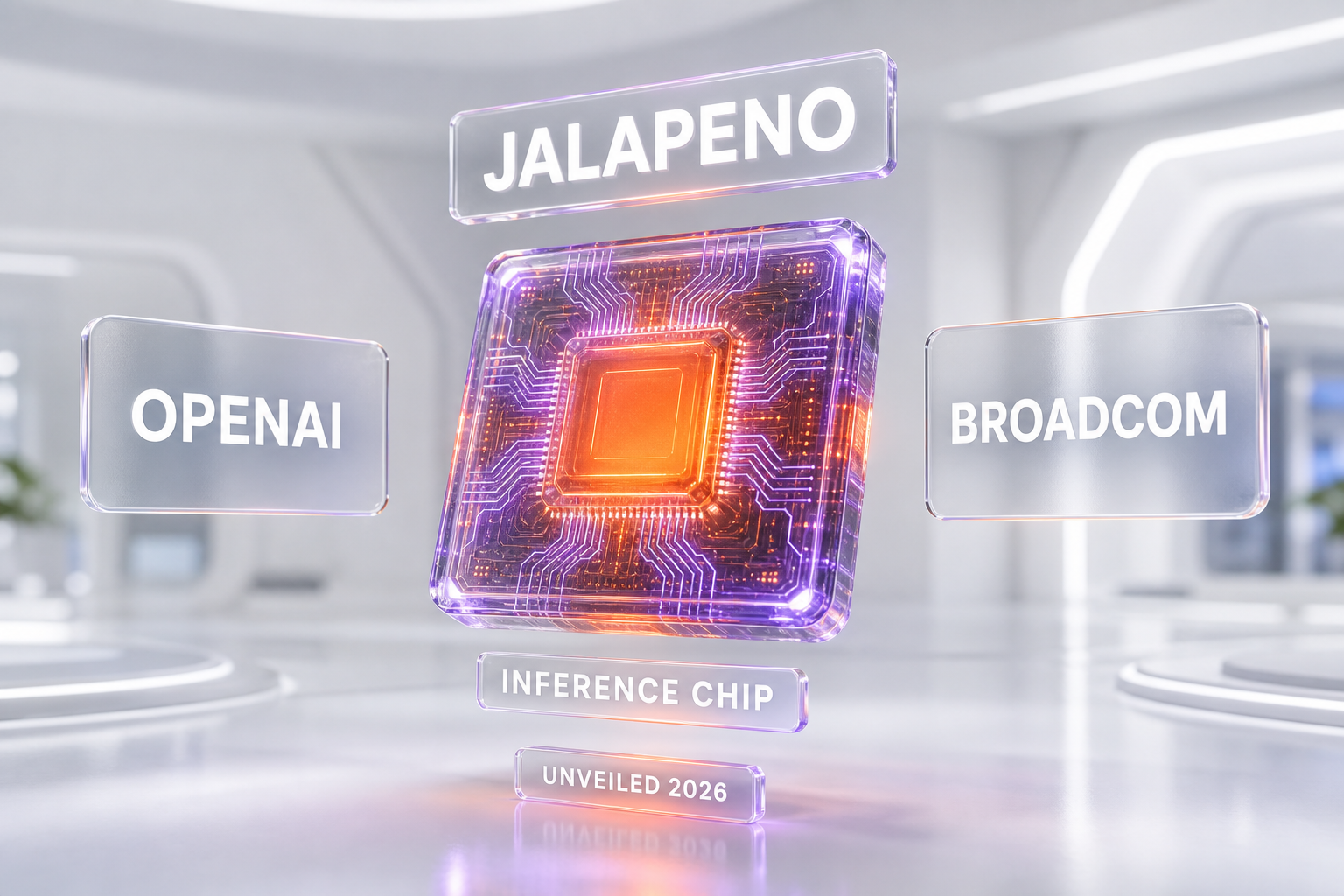
The firm says, unlike general-purpose graphics processing units (GPUs) used in most AI servers today, this Application-Specific Integrated Circuit (ASIC) is built from scratch strictly for AI inference, the day-to-day work of running an existing model to answer user prompts, write text, or execute code.
Why this matters
Today, most AI systems rely on powerful GPUs. While highly effective, these processors were originally designed for broad graphics processing, making them incredibly expensive and power-hungry when handling massive, everyday consumer traffic.
OpenAI’s new chip shifts the strategy toward total architectural optimization.
"Jalapeño was designed from the ground up for LLM inference using detailed insights from our close collaboration with OpenAI researchers,” Richard Ho, Head of OpenAI’s Hardware Program said at the launch.
“We optimized the architecture around the kernels, memory movement, networking, and serving patterns that matter most for frontier AI models. Based on early testing, Jalapeño will efficiently execute our most important workloads close to the hardware's theoretical limits."
What changes with Jalapeño?
By tailoring the hardware directly to the software, OpenAI and its partners say the chip delivers a few massive upgrades.
First, it brings drastically lower costs, with early industry reports indicating it could cut inference costs by roughly 50% compared to standard cloud infrastructure.
Second, the chip offers massive energy efficiency by delivering substantially better performance-per-watt than current state-of-the-art options. This allows data centers to pull more compute capacity out of the exact same power grid allocation.
Finally, the project achieved unprecedented development speed, moving from an initial blank-slate concept to final manufacturing readiness (tape-out) in just nine months. This process was partially accelerated by OpenAI using its own AI models to optimize the layout and architecture.
OpenAI co-developed the chip with semiconductor giant Broadcom, which provided critical silicon implementation and networking technology, including its Tomahawk networking platform. Physical server hardware, circuit boards, and rack integration are being handled by engineering partner Celestica, with manufacturing slated for Taiwan Semiconductor Manufacturing Company (TSMC).
Loading comments...
Leave a comment