



The announcement was made by the International Telecommunication Union (ITU), the specialised United Nations agency for digital technologies and information and communication technologies, on July 2, 2026. President Kagame will co-chair the commission alongside Marc Benioff, while ITU Secretary-General Doreen Bogdan-Martin will serve as vice-chair.
The AI for Good Global Commission brings together more than 40 founding members, including heads of state and government, technology executives, and leaders of international institutions, with the goal of identifying practical ways to strengthen trust, expand access and unlock AI’s potential to address global challenges.
The commission seeks to connect leaders involved in building technology, deploying it at scale, shaping policy and representing communities to promote responsible AI solutions across sectors and borders, while ensuring developing countries are part of the global AI conversation.
“Technology is supposed to be a force for good, and we have a responsibility to use it accordingly,” Kagame said, according to the statement announcing the launch of the commission. “Let us work together to reduce inequality, and allow more and more of our citizens to benefit from the good AI can deliver to all of us.”
The commission’s launch comes amid growing global efforts to ensure artificial intelligence contributes to inclusive development. According to the statement, about 2.2 billion people remain offline, limiting their ability to benefit from advances in AI and other digital technologies.
A key focus of the commission will be bridging digital divides and ensuring AI becomes a tool for solving global challenges rather than widening existing inequalities.
Benioff said the future of AI depends not only on economic opportunities created by the technology but also on building trust.
“The promise of AI is built on not only incredible opportunities for the growth of our economy, but on the foundation of trust that is required for our shared success,” he said.
The commission builds on the work of the multi-stakeholder ITU/UNESCO Broadband Commission for Sustainable Development, which has contributed to global efforts on connectivity, digital inclusion and economic development.
Bogdan-Martin said collaboration across sectors would be essential to ensure AI serves communities worldwide.
“No organization can single-handedly put AI at the service of all humanity,” she said. “It will take collective leadership and the combined expertise of partners from across sectors to ensure AI benefits all people, everywhere.”
The AI for Good Global Commission will hold its inaugural meeting in Geneva, Switzerland, during the AI for Good Global Summit 2026, scheduled for July 7–10, 2026.
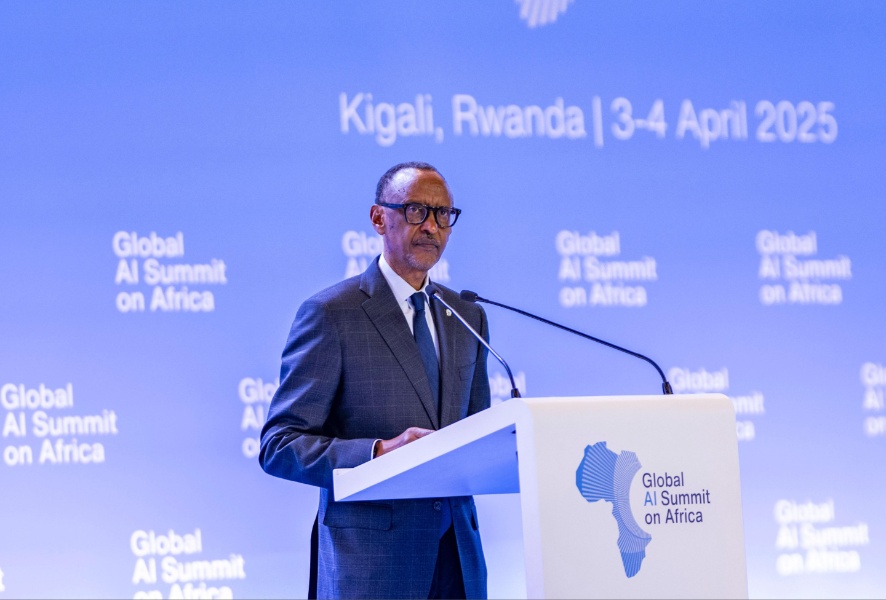
Kagame’s appointment builds on his continued advocacy for Africa’s participation in the global AI revolution. During the inaugural Global AI Summit on Africa 2025, he called on African countries to invest in digital infrastructure, skills development and cooperation to ensure the continent competes in AI rather than remains a consumer of technologies developed elsewhere.
“We have to adapt, cooperate, and compete because it is in our best interest to do so,” Kagame said at the summit.
He has also emphasised the need for AI to be used as a tool for economic transformation, social progress and reducing inequalities, while warning against allowing the technology to negatively influence critical areas such as politics and diplomacy.
Following his 2025 remarks, Rwanda has continued to position itself at the forefront of efforts to harness AI for good through initiatives across sectors such as healthcare, agriculture, public administration, and urban planning.
In June 2026, the Cabinet, chaired by President Kagame, approved the establishment of the National Artificial Intelligence Agency, which will drive AI development, innovation, adoption, investment and governance in support of Rwanda’s digital transformation and economic growth.
The agency is expected to play a central role in coordinating Rwanda’s AI agenda as the country seeks to strengthen its position as a regional technology and innovation hub.
The founding members of the AI for Good Global Commission include leaders from major technology companies, international organisations and governments, including representatives from Microsoft, Google, Amazon, NVIDIA, UNDP, UNESCO and the World Trade Organization.
Loading comments...
Leave a comment